


Start with broadcast bait, not a shovel. Area-wide baiting is the foundation of effective fire ant control, and eradication is not a realistic goal.pdf) in established North American infestations. The practical target is suppression: fewer mounds, fewer stings, and a yard you can actually use.
Your immediate action checklist:
- Apply a granular bait across the entire yard when soil surface temperatures are between 70°F and 90°F and ants are actively foraging.
- Do not disturb mounds before or right after baiting. Disturbance pushes queens deeper or triggers satellite colonies.
- Keep children and pets off treated areas until the product label’s re-entry interval has passed.
- Wait 7–10 days after broadcasting bait, then spot-treat any visible nuisance mounds with a liquid drench or dry mound product.
- Call a licensed pest control professional if you have large acreage, mounds near electrical equipment, livestock, or a pattern of re-infestation after repeated DIY attempts.
One rule of thumb: if you can count more mounds than you can treat in 30 minutes, area-wide baiting is not optional. It is the only cost-effective approach at scale.
Table of Contents
- What fire ant control options are available, and when should you use each?
- How do granular baits work, and when should you apply them?
- How do you safely treat individual mounds?
- Which home remedies actually work, and which ones are dangerous?
- Can biological control agents reduce fire ant populations?
- What does a practical IPM schedule look like for your yard?
- What safety and label rules do you need to follow?
- When should you call a licensed pest control professional?
- Key Takeaways
- Why the “kill it fast” instinct usually backfires
- Get professional fire ant treatment from Arsenal Pest Control
- Useful sources and further reading
What fire ant control options are available, and when should you use each?
Fire ant pest control falls into five broad categories. Each has a different role in an integrated pest management (IPM) program, and choosing the wrong tool for the situation is the most common reason homeowners stay frustrated.
| Treatment Type | How It Works | Speed | Best Use Case |
|---|---|---|---|
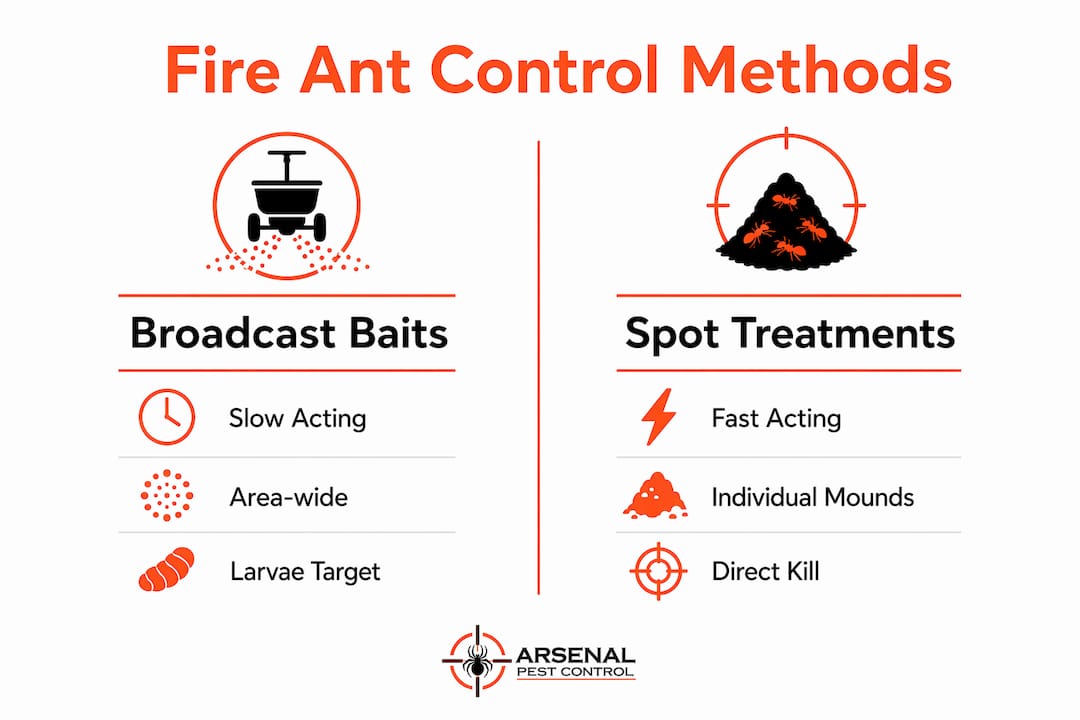
| Granular broadcast bait | Workers carry slow-acting toxicant or IGR to queen | Slow (1–2 months) | Area-wide suppression; preventive treatment |
| Contact broadcast granules/spray | Kills foragers on contact; residual in soil | Medium (days–weeks) | High-sensitivity zones (patios, play areas) |
| Liquid mound drench | Fast-acting insecticide soaks entire mound | Fast (hours) | Nuisance mounds in high-traffic areas |
| Dry mound treatment | Powder applied over mound surface | Medium (days) | Convenient spot treatment between bait cycles |
| Physical/biological methods | Disruption, hot water, phorid flies, microsporidia | Variable | Supplemental; not standalone solutions |
The core principle: bait first across the whole yard, then spot-treat the mounds that remain or pop up in sensitive spots. Trying to control fire ants by treating only visible mounds is a losing strategy. For every large mound you see, there are smaller, invisible colonies already establishing nearby. Baiting addresses those before they become problems.
How do granular baits work, and when should you apply them?

Granular baits are the workhorse of any fire ant infestation solution. Understanding why they work slowly is the key to using them correctly.
The mechanics behind slow-acting bait
Adult fire ants cannot swallow solid food. Workers carry bait granules back to the mound and feed them to larvae, which convert the solid material into liquid. That liquid gets shared throughout the colony, eventually reaching the queen. Slow-acting baits work precisely because they do not kill foragers before they return to the mound. A fast-acting contact poison would eliminate workers on the spot and never touch the queen. The colony survives, and you are back to square one in a few weeks.
Baits containing insect growth regulators (IGRs) like s-methoprene or pyriproxyfen disrupt egg and larval development and can take two months or more to reach peak effect. Baits with metabolic inhibitors like hydramethylnon typically show visible results in two to four weeks. Some products combine both for a faster initial knockdown with longer-lasting suppression.
Timing and the foraging test
Apply bait only when ants are actively foraging. The surface temperature window is 70°F–90°F, which typically means morning or evening applications in summer and midday in spring or fall. Before you open the bag, run a quick test: place a greasy potato chip or a small piece of hot dog near a mound and check back in 20–30 minutes. If ants have found it, they will find the bait. If they ignore it, either the temperature is off or the bait has gone stale.
Pro Tip: Never apply bait to wet grass or before rain or irrigation. Moisture destroys bait attractiveness within hours. Wait until the grass is dry and no rain is forecast for at least 24–48 hours. Opened bait packages lose effectiveness within a few weeks as the oil carrier goes rancid — buy only what you will use in one season.
Application rates, equipment, and cost
Apply at roughly 1–1.5 lbs per acre. A standard push-type fertilizer spreader puts out far too much product. Use a hand-held seed spreader set to the smallest opening for small yards, or a power-operated spreader for larger properties. At roughly $22 per pound for larger quantities, treating at 1.5 lbs per acre can cost about thirty dollars per acre per application.
| Bait Type | Active Ingredient | Typical Timeline | Notes |
|---|---|---|---|
| Metabolic inhibitor | Hydramethylnon | 2–4 weeks | Faster visible results |
| IGR | S-methoprene, pyriproxyfen | 6–10 weeks | Longer-lasting suppression |
| Combination | Methoprene + hydramethylnon | 3–6 weeks | Balanced speed and duration |
How often to apply
In areas with high fire ant pressure, two to four applications per year may be necessary. In urban yards, one spring and one fall application is usually sufficient. A practical memory trick: treat around Easter, Independence Day, and Labor Day. Do not skip the fall application. You may not see dramatic results before winter, but you will have significantly fewer mounds the following spring.
When used correctly, broadcast granular baits provide about 80% control. That is not 100%, and it is not meant to be. The remaining mounds get handled with targeted spot treatments.
How do you safely treat individual mounds?
Mound treatments are for mounds that are already large, in a high-traffic area, or a direct hazard. They are not a substitute for area-wide baiting. Think of them as the second step in the two-step method: broadcast bait first, then treat visible nuisance mounds 7–10 days later.
Step-by-step: liquid mound drench
Liquid drenches kill a mound within hours and are the fastest option available.
- Gather your materials: a watering can or bucket, the labeled insecticide (permethrin or carbaryl formulations are common), and PPE (gloves, long sleeves, closed-toe shoes).
- Mix the insecticide per label directions. A typical rate is 1.5 fl. oz. per gallon of water.
- Apply roughly one-quarter of the total volume in a 10–12 inch band around the outside of the mound first. This cuts off escape routes through underground foraging tunnels.
- Pour the remaining volume directly onto and into the mound. Depending on mound size, you will use 1–2 gallons total.
- Do not disturb the mound before or during application. Disturbance sends the queen deeper, and you lose the window for effective treatment.
- Keep children and pets away from the treated area until it has dried completely.
Step-by-step: dry mound products
Dry powders are more convenient but slower, typically taking a few days to work.
Sprinkle the specified amount of powder evenly over and around the mound surface.
Distribute it uniformly. Uneven application is the main reason dry treatments fail to eliminate the whole colony.
Avoid leaving exposed powder where it is visible in a lawn or play area. Some situations call for a drench instead.
Check the mound after 3–5 days. If activity continues, a follow-up drench may be warranted.
Pros, cons, and the queen-escape problem
The single biggest mistake with mound treatments is disturbing the mound before applying the product. Even walking too close can trigger the queen to move deeper or relocate to a satellite colony. Treat calmly, treat thoroughly, and treat from the outside in.
Liquid drenches are faster but labor-intensive. Dry products are quick to apply but less reliable. Neither provides the area-wide residual that baiting does. Use them for the mounds that matter most, not as your primary strategy.
Safety callout: Always wear chemical-resistant gloves when mixing liquid drenches. Rinse mixing containers thoroughly before disposal. Never pour leftover mixed solution down a storm drain.
Which home remedies actually work, and which ones are dangerous?
Physical removal and DIY home remedies are a mixed bag. A few have genuine utility; most are either ineffective or actively dangerous.
What can actually help
Shoveling a mound into a bucket of soapy water works for small, isolated colonies in a garden bed, provided you capture the queen. The catch: fire ant queens are deep in the mound and fast to flee. Success rate is low unless the colony is very young and small. It is a reasonable option for a single new mound in a contained area, not for a yard with dozens of established colonies.
Hot water (about 190°F–212°F) poured directly into a mound kills ants on contact through thermal shock. Research suggests it can reduce mound activity, but it takes multiple treatments and is labor-intensive, requires care to avoid burns, and does not reliably reach the queen. For a homeowner with a few mounds near a garden where chemical use is a concern, it is a legitimate low-toxicity option.
What to avoid entirely
Pouring gasoline, diesel, bleach, or ammonia into a fire ant mound is not a pest control method. It is a soil contamination event. These substances do not reliably kill the queen, they persist in the soil and groundwater, and they are illegal to use as pesticides in most states. Flaming a mound with a torch is equally ineffective and adds a fire hazard. None of these approaches come close to the 80% control a properly applied bait achieves.
Grits, club soda, and similar folk remedies have no scientific support. They do not kill fire ant colonies. Skip them.
Physical removal makes sense for a single new mound in a raised bed or a spot where you cannot use chemicals. For anything beyond that, the time and effort are better spent on a proper bait application. Baiting one acre takes about 15 minutes with a hand spreader and delivers far better results than an afternoon of shoveling.
Can biological control agents reduce fire ant populations?
Biological control is real, it is being actively used, and it is genuinely not a quick fix. Understanding what it can and cannot do helps you set the right expectations.
The two main agents in use are:
- Pseudacteon phorid flies (decapitating flies): These small parasitic flies hover over disturbed fire ant mounds and lay eggs on worker ants. The larvae develop inside the ant’s head, eventually killing it. Multiple species, including Pseudacteon tricuspis, P. curvatus, and P. litoralis, have been successfully released in the United States.pdf). Their presence disrupts foraging behavior and applies ongoing population pressure.
- Thelohania solenopsae: This microsporidian pathogen infects fire ant colonies and directly weakens queens, causing them to produce fewer offspring over time. Infected queens weigh roughly 50% less than healthy ones. The disease is self-sustaining once established and has been inoculated into colonies across at least ten states.
Neither agent delivers the fast knockdown a drench provides. Their value is long-term area suppression, not emergency treatment. Think of them as background pressure that, over years, can help push fire ant populations toward the lower densities seen in their native South American range, where natural enemies keep them in check.
Homeowners can support biological control by reducing broad-spectrum insecticide use in areas where phorid flies are established, and by coordinating with local university extension programs or USDA-ARS research projects. Choosing eco-friendly pest control approaches that preserve non-target insects gives biological agents the best chance to work alongside chemical suppression.
What does a practical IPM schedule look like for your yard?
An integrated pest management plan for fire ants is not complicated. It is consistent. The homeowners who see the best results are the ones who treat on a schedule, monitor between treatments, and adjust based on what they find.
Annual IPM calendar
- Early spring (March–April): Broadcast granular bait across the entire property once soil temperatures reach 70°F. This is your most important application. It targets new colonies establishing after winter and sets the baseline for the season.
- Late spring/early summer (May–June): Scout for new mounds. Apply liquid drenches or dry products to any nuisance mounds in high-traffic zones. Check bait freshness if you have any left from spring.
- Midsummer (July–August): Apply a second broadcast bait if fire ant pressure is high. In Arizona’s heat, apply in the early morning or evening when surface temps drop into the foraging range.
- Fall (September–October): Apply broadcast bait again. This is the treatment most homeowners skip, and it is the one that pays off most visibly the following spring.
- Year-round: Spot-treat any mound that appears near electrical equipment, HVAC units, irrigation boxes, or children’s play areas immediately with a drench.
Monitoring and success metrics
| Monitoring Step | Method | Success Indicator |
|---|---|---|
| Mound count | Walk the property monthly; mark mound locations | Fewer new mounds than the prior month |
| Forager activity | Potato chip/hot dog test near mounds | Reduced activity within 2–4 weeks of bait application |
| Re-infestation check | Post-treatment scout at 30 and 60 days | Less than 20% of original mound count remaining |
| Record keeping | Log treatment dates, products, and mound counts | Trend line showing seasonal suppression |
Neighborhood coordination
Fire ants do not respect property lines. A newly mated queen can fly hundreds of yards and establish a colony in a yard you treated last week. Block-level treatment programs materially reduce re-infestation by removing the reservoir of colonies in adjacent untreated yards. Talk to neighbors, share bait costs, and coordinate application timing. Your local cooperative extension office can connect you with community IPM resources and, in some areas, subsidized neighborhood treatment programs. For HOA communities, coordinated property maintenance programs that include scheduled pest management are one of the most effective long-term tools available.
What safety and label rules do you need to follow?
Label compliance is not optional. The product label is a legal document, and applying a pesticide in a manner inconsistent with its label is a federal violation under FIFRA.
The label is the law. Read it before you open the bag, not after. Pay particular attention to the re-entry interval, the application rate, and any restrictions near water bodies or food gardens.
PPE basics: Wear chemical-resistant gloves when mixing liquid drenches. Long sleeves and closed-toe shoes are the minimum for any granular application. Eye protection is required when mixing concentrates.
Children and pets: Keep them off treated areas until the re-entry interval on the label has passed. For most granular baits, this is once the product has been watered in or the granules are no longer visible on the surface. For liquid drenches, wait until the treated area is fully dry.
Environmental precautions:
- Never apply granular products to hard surfaces like driveways or sidewalks where runoff carries them directly into storm drains.
- Do not apply before rain or irrigation. Runoff from treated areas can harm aquatic organisms.
- Avoid applying contact insecticides to flowering plants where bees are active. Apply in the early morning or evening when bee activity is low.
- Some long-residual broadcast granular products containing fipronil are restricted-use pesticides due to aquatic toxicity concerns. These may only be applied by licensed commercial applicators. Do not attempt to source or apply them yourself.
For families with children or pets, safe treatment options that minimize exposure risk are available and worth discussing with a licensed applicator before you treat.
This article is general information, not professional pest management advice. Confirm current product registrations and local restrictions with your state extension service or a licensed applicator for your specific situation.
When should you call a licensed pest control professional?
DIY fire ant control works well for average residential yards with moderate pressure. There are situations where it does not, and recognizing them early saves money and frustration.
Call a licensed professional when:
- You have more than 20–30 mounds per acre, or the infestation covers multiple acres.
- Mounds are located near electrical equipment, irrigation control boxes, HVAC units, or livestock housing. Fire ants chew wiring and can cause equipment failures.
- You have had two or more DIY treatment cycles without meaningful reduction in mound counts.
- You need a long-residual broadcast treatment (fipronil-based products) that is restricted to licensed applicators.
- You are managing a commercial property, HOA common area, or agricultural land where regulatory compliance and documentation matter.
- You have children, elderly residents, or individuals with known allergies to fire ant venom on the property.
What a licensed applicator brings: Access to restricted-use granular products that provide season-long control from a single application. Calibrated equipment that applies bait at the correct rate across large areas. Written treatment records, liability coverage, and follow-up guarantees. Knowledge of local re-infestation pressure and the most effective products for your specific region.
Questions to ask before hiring:
- What products will you use, and are they labeled for my property type?
- What is the expected timeline for visible results?
- Do you offer follow-up visits if mound counts do not decrease?
- How do you handle sensitive areas near water features or vegetable gardens?
For ant removal across the Phoenix metro area, a licensed local service brings both the products and the regional knowledge that generic national programs often lack. Knowing which fire ant species are active in your area, how local soil conditions affect bait uptake, and when seasonal pressure peaks in your specific zip code makes a real difference in outcomes.
Key Takeaways
Effective fire ant suppression requires bait-first area treatment, targeted mound spot-treatment, and consistent seasonal monitoring — not a single application and a wait.
| Point | Details |
|---|---|
| Bait first, always | Broadcast granular bait area-wide before spot-treating mounds; baits reach the queen, contact sprays alone do not. |
| 80% control is the realistic target | Properly applied broadcast baits typically deliver about 80% mound reduction; combine with mound treatments for the rest. |
| Timing determines success | Apply bait when surface temps are 70°F–90°F and ants are actively foraging; never apply before rain or on wet grass. |
| Suppression, not eradication | Eradication is not achievable in established North American infestations; plan for recurring seasonal treatments. |
| Arsenal Pest Control | For persistent infestations, large properties, or restricted-use product needs in the Queen Creek and greater Phoenix area, Arsenal Pest Control provides licensed inspection, broadcast baiting, and targeted mound treatment programs. |
Why the “kill it fast” instinct usually backfires
Most homeowners reach for the fastest-acting product they can find. That instinct makes sense, but it is the main reason so many fire ant treatments fail. A contact insecticide that kills foragers on the spot never reaches the queen. The colony survives, workers are replaced within weeks, and the mound is back. You have spent money and time to accomplish nothing permanent.
The research is consistent on this: slow-acting baits and IGRs are the industry standard for sustainable suppression precisely because they exploit the colony’s own biology. Workers share food throughout the colony. That sharing mechanism, which makes fire ants so successful as a species, is also what makes them vulnerable to a well-designed bait.
The other mistake is treating in isolation. A neighbor’s untreated yard is a constant source of newly mated queens looking for territory. Neighborhood coordination is not a nice extra. It is the difference between a yard that stays manageable and one that re-infests every season regardless of what you apply.
Arsenal Pest Control’s approach is grounded in these same principles: start with an area-wide bait program, follow up with targeted treatments for problem mounds, and build a monitoring schedule that catches re-infestation early. Family-owned and locally operated across Queen Creek, San Tan Valley, Gilbert, Chandler, Mesa, Apache Junction, and Florence, the team understands the specific pressure patterns and seasonal timing that affect Arizona properties.
Get professional fire ant treatment from Arsenal Pest Control
Persistent fire ant infestations in the greater Phoenix area call for more than a bag of bait from a hardware store. Arsenal Pest Control offers licensed inspection, calibrated broadcast baiting, targeted mound treatments, and follow-up monitoring across Queen Creek, San Tan Valley, Gilbert, Chandler, Mesa, Apache Junction, and Florence, with no long-term contracts required.

The difference between a single DIY application and a professional program is access to restricted-use products, properly calibrated equipment, and a follow-up plan that catches re-infestation before it rebuilds. Arsenal Pest Control’s pest control services include a written treatment plan, safety-first application practices for families and pets, and a team that knows Arizona’s fire ant pressure cycles firsthand. Request your inspection today and get a yard you can actually use again.
Useful sources and further reading
| Source | What You’ll Find |
|---|---|
| Mississippi State University Extension — Control Fire Ants in Your Yard | Detailed bait mechanics, mound treatment comparisons, and product rate guidance for homeowners |
| Texas A&M AgriLife — Fire Ant Control Methods | The two-step method explained, bait application equipment, and restricted-use product guidance |
| USDA ARS — Oi & Valles 2008.pdf) | Research basis for IPM suppression framing and biological control agent development |
| UC IPM — Red Imported Fire Ant Management Guidelines | Bait freshness, storage, and application timing guidance from the University of California |
| University of Tennessee Extension — Managing Fire Ants Around Homes and In Neighborhoods | Neighborhood coordination strategies, block programs, and monitoring protocols |
| USDA ARS — Williams & deShazo, Biological Control of Fire Ants.pdf) | Phorid fly and Thelohania solenopsae research, biological control agent status and limitations |
| NC State Cooperative Extension — Control Fire Ants in Pastures, Hayfields and Barnyards | Pasture and large-acreage bait options, spreader guidance, and cost estimates |
| PMC — Naturally Occurring Compounds as Alternatives to Synthetic Insecticides | Research summary on organic and naturally derived fire ant control options and their current market status |
Recommended
- Arizona Ant Infestation Identification Guide for Homeowners – Arsenal Pest Control
- Safe Pest Control for Kids and Pets: A Family Guide – Arsenal Pest Control
- What Is Termiticide? A Practical Guide for Homeowners – Arsenal Pest Control
