


A wood-destroying insect (WDI) inspection, formally documented on the NPMA-33 form or a state-equivalent WDIR, is a licensed visual examination of all readily accessible areas of a structure to identify current or past evidence of termites, carpenter ants, carpenter bees, and wood-boring beetles, plus conditions that invite them. If you’re buying a home, you should order one before closing. If you’re selling, getting one early prevents surprises that stall a deal.
Two things to know right away:
- The NPMA-33 is the nationally recognized standard form; many states also have their own required WDIR (such as North Carolina’s WDIR-100 or the Texas Department of Agriculture’s official form), and lenders often specify which one they’ll accept.
- Most lenders, including FHA and VA lenders, require a licensed inspector’s signature on the correct form. A homeowner’s self-inspection carries no legal standing for a real estate transaction.
- Reports are typically accepted by lenders for a limited period, so timing your inspection relative to closing matters is important.
Table of Contents
- What does a wood destroying insect inspection actually cover?
- What does a WDI report show, and how do you read it?
- What inspectors do not check, and why that matters
- What happens if the report shows evidence of insects?
- Who can legally perform an official WDI inspection?
- How much does a WDI inspection cost, and how long does it take?
- How to prepare your home for a WDI inspection
- How to read common entries on a WDI report
- When should you order a WDI inspection?
- Key Takeaways
- Why licensed WDI inspections protect everyone in the transaction
- Schedule your WDI inspection with Arsenal Pest Control
- Authoritative sources and official forms
What does a wood destroying insect inspection actually cover?
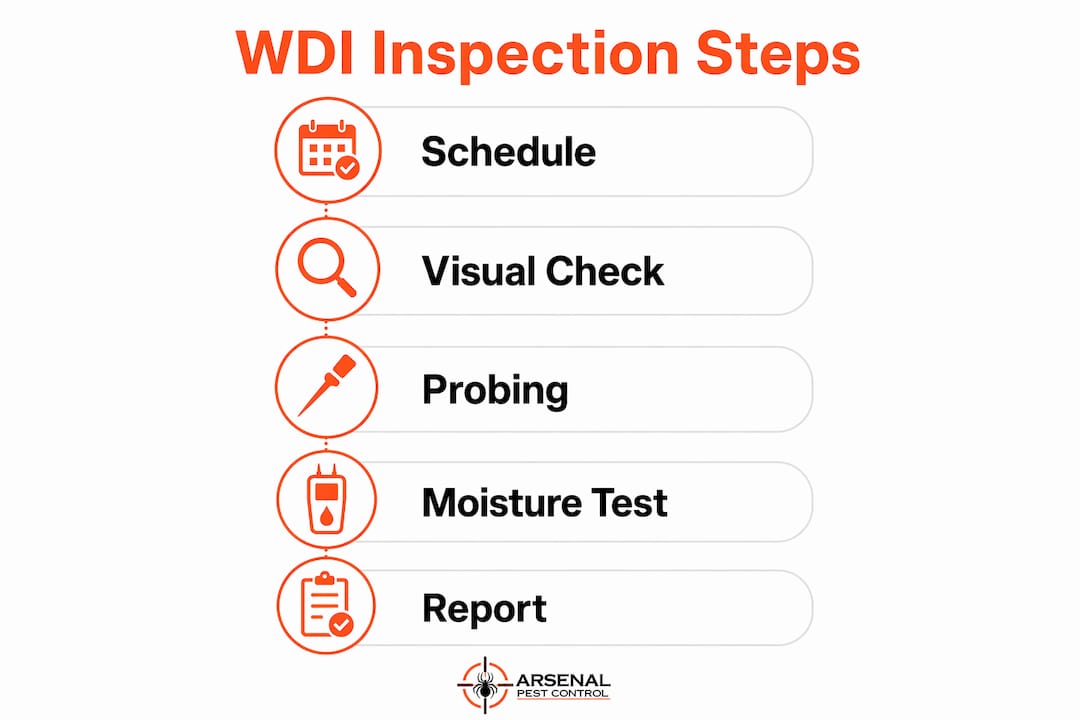
A WDI inspection is a visual exam combined with sounding and probing of accessible wood. The inspector walks every accessible area of the structure, tapping and probing suspect members, looking for physical evidence of infestation or conditions that make infestation likely.
What the inspector checks:
- Exterior perimeter: foundation walls, soil-to-wood contact points, decks, porches, wood fencing attached to the structure, planter boxes abutting siding, and the roofline where visible
- Interior living areas: baseboards, door frames, window sills, exposed wood members, and any area where moisture damage is visible
- Basement and crawlspace: floor joists, sill plates, pier posts, and sub-floor sheathing; inspectors probe these members with a screwdriver or pick to detect hollowing from termite galleries
- Attic: exposed rafters, ridge boards, and any wood in contact with insulation or roof decking
The core tools are simple: a bright flashlight, a probe or screwdriver for sounding, and sometimes a moisture meter. Sounding means tapping wood and listening for the hollow thud that signals galleries eaten by subterranean termites. Probing means pressing a pick into wood to feel whether it collapses, which indicates active or past damage. Under Arizona Administrative Code § R3-8-307, inspectors are specifically authorized to use non-destructive probing and sounding techniques.
When an area can’t be reached, the inspector notes it on the report. Crawlspaces with less than 24 inches of clearance between the floor joist and grade level are commonly listed as inaccessible under Arizona regulations and similar state rules.
Pro Tip: Clear a path to your crawlspace access hatch before the inspector arrives. Move stored items at least two feet from the foundation walls, and make sure the attic hatch isn’t blocked by insulation or boxes. Every inaccessible-area note on the report is a gap in coverage that could matter at closing.
A WDI inspection is a visual exam of what is accessible on the day of the inspection. It is not a guarantee that no insects exist behind finished walls or under fixed floor coverings. Treating it as a guarantee is the most common misunderstanding buyers bring to the closing table.
What does a WDI report show, and how do you read it?

The report’s purpose is to document visible evidence, or the absence of it, on the specific date of the inspection, along with any conditions that make infestation more likely. It is not a warranty against future infestations and not a structural damage appraisal.
Standard forms like the NPMA-33 and state WDIRs share a common structure:
| Form Section | What It Contains |
|---|---|
| Property identification | Address, inspector name, license number, inspection date |
| Section II — Inspection findings | Yes/No checkboxes for active infestation, previous infestation, and previous treatment for each pest type |
| Section III — Recommendations | Whether corrective or preventive treatment is recommended and why |
| Section IV — Inaccessible areas | List of areas not inspected and the reason for each exclusion |
| Section V — Attachments and signatures | Inspector signature, license number, treatment contracts, warranties if applicable |
Typical findings you’ll see reported include:
- Live insects or mud tubes (shelter tubes built by subterranean termites along foundation walls)
- Frass (sawdust-like droppings from carpenter ants, carpenter bees, or wood-boring beetles)
- Exit holes in wood from powder post beetles or old house borers
- Visible structural damage such as hollowed or collapsed wood members
- Conducive conditions such as wood-to-ground contact, excessive moisture, cellulose debris under the structure, or insufficient crawlspace ventilation
Photos matter. Many inspectors attach photos to the report, especially when evidence is found. If your report references findings in specific locations, photos are the fastest way to understand what the inspector actually saw. Ask for them if they aren’t automatically included.
According to NC Department of Agriculture guidance, inspectors must report all visible evidence of current or past wood-destroying insect activity and any conditions conducive to subterranean termites. The report must clearly indicate whether insects have been or are in the wooden members.
What inspectors do not check, and why that matters
The inspection is visual and limited to readily accessible areas. It is not a structural damage report, and it does not cover everything that could go wrong with wood in a home.
Common exclusions:
- Inside finished walls, under carpet, or beneath fixed floor coverings
- Areas requiring destructive access (removing drywall, lifting tile)
- Crawlspaces with insufficient clearance
- Areas blocked by stored items, built-in appliances, or furniture
- Wood-decay fungi (wood rot) unless it’s noted as a condition conducive to termites
- Structural defects, plumbing leaks, or electrical issues unrelated to insect activity
- Detached structures (sheds, freestanding garages) unless specifically requested
Why this matters: a report with no evidence of infestation doesn’t mean no insects exist. It means no insects were visible in accessible areas on that date. The NPMA-33 form language states explicitly that hidden damage may exist and recommends contacting a qualified structural professional if damage questions arise. A buyer who reads “no evidence found” and assumes the home is insect-free is misreading the report.
If the report lists inaccessible areas, ask whether access can be created before closing. Many inspectors will return for a supplemental inspection once an area becomes accessible, though additional fees may apply.
Pay close attention to the inaccessible-area section of any WDI report. If a crawlspace, attic section, or wall cavity is listed as inaccessible, request that the seller provide access before closing. An uninspected area is not a cleared area.
What happens if the report shows evidence of insects?
Live insects on the report almost always prompt a treatment recommendation. Evidence of past activity without documentation of prior treatment usually does too. The key distinction is whether prior treatment has been documented.
Immediate next steps when evidence appears:
- Confirm the species. Subterranean termites, drywood termites, carpenter ants, and wood-boring beetles each require different treatment approaches. The report should name the pest; if it doesn’t, ask the inspector.
- Request a treatment estimate. The inspector’s company can typically provide one, but you’re not obligated to use them. Get at least one independent estimate.
- Get a structural evaluation if damage is noted. A WDI inspection is not a structural damage assessment. If the report indicates visible damage to wood members, hire a structural engineer or licensed contractor to quantify the scope of repairs before you negotiate.
- Obtain documentation and warranty. If treatment is performed, a copy of the written agreement and any warranty must be attached to the WDIR. Keep these documents. Lenders often require them, and they transfer value to a future buyer.
Negotiation options in a real estate transaction:
- Repair credit: seller provides a dollar credit at closing; buyer arranges treatment after closing
- Seller-paid treatment: seller contracts and pays for treatment before closing; buyer receives documentation
- Escrow hold: funds held in escrow pending completion of treatment or repairs
- Price reduction: buyer accepts the property as-is in exchange for a lower purchase price
Treatment options vary significantly by pest. Subterranean termites are typically treated with liquid soil applications or bait systems, sometimes with multi-year warranties. Wood-boring beetles and carpenter bees may require surface treatments, moisture control, or in severe cases, fumigation. For safe treatment options when families with children or pets are involved, ask your pest control provider about low-impact approaches.
When a WDI report shows evidence, the inspector’s obligation is to report it. Contracting for treatment is a separate decision made by the buyer or seller. The report is the starting point for negotiation, not the end of it.
Who can legally perform an official WDI inspection?
Only a licensed pest control professional can issue an official WDI or WDIR report for a real estate transaction. In most jurisdictions, this means a certified applicator working under an active business license in the structural pest control category.
In Arizona specifically, Ariz. Admin. Code § R3-8-307 requires that only an applicator certified in wood-destroying organism management, working under a licensed business, may complete a WDIIR. Texas regulations similarly require a licensed certified applicator or technician in the Termite and Wood Destroying Insect Control category.
Credentials to verify before relying on a report:
- Company business license number (verify with your state department of agriculture or structural pest control board)
- Inspector’s individual license or certification number (should appear on the report itself)
- Proof of liability insurance
- Inspection Control Number (ICN) or unique report number, where required by state
- Signature of the certified applicator on the completed form
How to verify legitimacy:
- Look up the company’s license on your state agriculture department’s public license lookup tool.
- Confirm the inspector’s individual certification number matches state records.
- Check that the form used is the state-required form (NPMA-33 or state WDIR).
- Verify the report carries a date, address, and inspector signature.
The NC Department of Agriculture guidance notes that the WDIR-100 is the only form legal for real estate transactions in North Carolina, and only a licensed individual or someone working for a licensed company may issue it. Similar rules apply in most states.
One nuance worth knowing: WSDA guidance clarifies that the legal status of an inspection depends on how the report is used. A pre-sale inspection ordered by a homeowner may still be subject to full regulatory requirements if the report is later used in a transfer or refinance. Licensing and regulated procedures apply based on use, not just intent.
How much does a WDI inspection cost, and how long does it take?
Price and timeline vary by region, property size, and inspector. The ranges below reflect industry-typical figures for a standard single-family home.
| Price Range | What It Typically Includes | Average Inspection Duration |
|---|---|---|
| — | Visual inspection, standard WDIR form, basic report | — |
| — | Inspection plus photos, detailed report, crawlspace and attic access | — |
| — | Large or complex properties, supplemental inspections, rush scheduling | 90 minutes or more |
Local pricing varies. Arizona markets, for example, tend to be competitive given the high termite pressure in the region. Always confirm what the fee includes before booking.
Scheduling and timeline:
- Book at least 3–5 business days before you need the report; rush slots exist but cost more.
- Most inspectors deliver the completed report within 24–48 hours of the inspection.
- Lenders typically accept reports for a limited period from the inspection date. If closing is delayed beyond that window, a new inspection may be required.
- If treatment is recommended, factor in an additional 1–3 weeks for scheduling, completing, and documenting the treatment before closing.
Practical timing tips:
- Order the inspection immediately after a purchase contract is signed, not at the end of the due diligence period.
- Coordinate with your lender early to confirm which form they require and whether they have a preferred inspector list.
- If the report shows evidence and treatment is needed, build at least two weeks of buffer into your closing timeline.
How to prepare your home for a WDI inspection
Preparing the home increases the chance of a complete report and reduces inaccessible-area notes that can complicate a transaction.
Pre-inspection checklist:
- Clear the crawlspace access hatch and remove any stored items blocking the entry
- Move boxes, furniture, and stored goods at least two feet away from interior and exterior foundation walls
- Ensure the attic access hatch opens freely and isn’t blocked by insulation
- Trim shrubs, vines, and tree branches away from the siding and roofline
- Move firewood piles at least six inches from the structure (Arizona regulations flag firewood within six inches as a conducive condition)
- Locate any prior treatment records, warranties, or service agreements and have them ready for the inspector
- Unlock all outbuildings or detached structures if you want them included in the inspection
Pro Tip: If you have a pier-and-beam foundation, measure the clearance in your crawlspace before the inspector arrives. Less than 24 inches of clear space between the floor joist and grade is commonly listed as inaccessible. If you can safely increase access, do it before the appointment. For a full preparation checklist, see how to prepare your home for a pest inspection.
Sellers should also address obvious conducive conditions before the inspection: fix dripping faucets or leaking pipes under the structure, repair wood rot on window sills or door frames, and eliminate any wood-to-soil contact along the foundation. These items will appear on the report regardless, but correcting them before the inspection removes negotiating leverage from the buyer.
Do not enter a crawlspace yourself if you’re unsure of the clearance, the presence of standing water, or the structural integrity of the floor above. Leave confined-space access to the inspector, who carries appropriate equipment and insurance.
How to read common entries on a WDI report
Annotated examples show exactly how inspectors present evidence and what each entry means for your next move.
| Report Entry | What It Means | Homeowner Action |
|---|---|---|
| “Active infestation — subterranean termites observed at northwest foundation wall” | Live termites found; treatment is recommended | Get a treatment estimate immediately; notify lender |
| “Previous infestation — mud tubes, no live insects, no prior treatment documented” | Past activity with no proof of treatment; treatment likely recommended | Request treatment before closing; obtain warranty |
| “Previous infestation — mud tubes, prior treatment documented per attached warranty” | Past activity with documented treatment on file | Review warranty terms; confirm it transfers to new owner |
| “Conducive condition — wood-to-ground contact at rear deck posts” | Risk factor noted; no active infestation found | Correct the condition; seller should address before closing |
| “Inaccessible — crawlspace, insufficient clearance” | Area not inspected; no findings possible for that zone | Request access or supplemental inspection before closing |
| “Visible damage — hollowed sill plate, northeast corner” | Structural damage observed; extent unknown | Hire a structural engineer or contractor for damage assessment |
Common terms you’ll see on a report:
- Frass: fine, powdery droppings left by carpenter ants, carpenter bees, or wood-boring beetles; looks like sawdust near entry holes
- Shelter tube (mud tube): pencil-width tunnels of soil and debris built by subterranean termites along foundation walls to travel between soil and wood
- Probing: pressing a sharp instrument into wood to test for hollowness or soft spots caused by insect galleries
- ICN: Inspection Control Number, a unique identifier assigned to each report in states that require it
The distinction between Box A (active infestation) and Box B (previous infestation) on most forms is significant. Active means live insects were observed. Previous means evidence exists but no live insects were seen. Both can trigger treatment recommendations, but the urgency and negotiating dynamics differ. For more on reading treatment reports in Arizona, Arsenal Pest Control’s guide walks through the documentation in detail.
According to NPMA suggested guidelines, treatment should be recommended when live termites are found, and may be recommended when evidence exists without documentation of prior treatment. Prior documented treatments or active warranties can change that recommendation.
When should you order a WDI inspection?
Order one for virtually every home purchase. Refinancing may also require one if the lender requests it. Sellers benefit from ordering early, before listing, so they can address findings on their own timeline rather than under closing pressure.
For buyers:
- Order immediately after the purchase contract is signed, within the due diligence window
- Review the report before the inspection contingency deadline so you have time to negotiate
- Get repair or treatment estimates in writing before requesting credits or price reductions
- Confirm the report’s date relative to your closing date; a 90-day window is the common lender standard
For sellers:
- Order a pre-listing inspection to identify and correct conducive conditions before buyers see the property.
- Address obvious issues (wood rot, soil-to-wood contact, moisture problems) before the inspection.
- Disclose any known prior infestations or treatments to buyers, and have documentation ready.
- Attach existing warranties or service agreements to the WDIR when one is issued.
Timing recommendations:
- Align the inspection date so the report stays within the lender’s acceptance window through closing.
- If treatment is needed, schedule it within the first week after the inspection to leave time for documentation before closing.
- For properties with known prior treatment, verify that the warranty is transferable and request a copy of the original treatment contract.
Treat the WDI inspection as a risk-management tool, not a pass/fail test. Many older homes show some past evidence of insect activity. What matters is understanding what was found, what was treated, and what conditions remain, so you can negotiate and plan accordingly.
Key Takeaways
A licensed visual WDI inspection is the only legally recognized method for documenting wood-destroying insect evidence in a real estate transaction, and lenders typically accept reports for roughly 90 days from the inspection date.
| Point | Details |
|---|---|
| Licensed inspectors only | Only a certified pest control applicator under an active business license can issue a legally valid WDIR for a real estate transaction. |
| Visual exam with real limits | Inspectors check all accessible areas but cannot see behind finished walls, under fixed coverings, or in crawlspaces with less than 24 inches of clearance. |
| Reports document the date of inspection | The NPMA-33 and state WDIRs record visible evidence on that specific day; they are not warranties against future infestation. |
| Evidence triggers specific next steps | Active infestation prompts treatment; past evidence without prior treatment documentation usually does too. Get a structural evaluation if damage is noted. |
| Arsenal Pest Control | Arsenal Pest Control provides licensed WDI inspections and follow-up termite treatments in Queen Creek, San Tan Valley, Gilbert, Chandler, Mesa, Apache Junction, Florence, and surrounding Arizona communities. |
Why licensed WDI inspections protect everyone in the transaction
From Arsenal Pest Control’s perspective, the most underappreciated aspect of a WDI inspection is what it does for the seller, not just the buyer. Sellers who skip a pre-listing inspection often discover findings mid-transaction, when they have the least negotiating power and the least time to address them. A licensed inspection completed before listing gives sellers the chance to correct conducive conditions, document prior treatments, and enter negotiations with transparency rather than liability.
Arsenal Pest Control operates across Queen Creek, San Tan Valley, Florence, Gilbert, Chandler, Mesa, Apache Junction, and surrounding Arizona communities, where subterranean termite pressure is among the highest in the country. Arizona’s regulatory framework under Ariz. Admin. Code § R3-8-307 requires certified applicators for all WDIIRs, and Arsenal’s inspectors meet that standard. The company’s commitment to clear, complete reporting means every inaccessible area is noted, every conducive condition is documented, and clients receive a report they can actually use at the closing table.
The broader point: a licensed inspection is not a formality. It is the only document that gives buyers, sellers, and lenders a shared, legally recognized picture of the property’s condition on a specific date. Skipping it, or relying on an unlicensed inspection, leaves everyone exposed.
Schedule your WDI inspection with Arsenal Pest Control
Arsenal Pest Control offers licensed termite and WDI inspections across Queen Creek, San Tan Valley, Gilbert, Chandler, Mesa, Apache Junction, Florence, and surrounding Arizona communities. No long-term contracts, no guesswork about what’s included.

When a report shows evidence, Arsenal’s team handles the follow-up: subterranean and drywood termite treatments, bait systems, liquid soil applications, and documented service agreements that satisfy lender requirements. Carpenter bee activity found during an inspection? That’s covered too. Every treatment comes with clear documentation you can attach to the WDIR and hand to your lender or future buyer.
Ready to schedule? Visit Arsenal Pest Control’s termite inspection and treatment services page to book an appointment, or call directly for same-week availability. For homeowners in Queen Creek specifically, free inspection services are available. Get the report your lender needs and the clarity your transaction depends on.
Authoritative sources and official forms
Official forms and regulatory guidance are the foundation of any WDI inspection. These sources let you verify facts, view sample forms, and understand the legal scope of inspections in your state.
| Source | What It Contains | Why You’d Open It |
|---|---|---|
| NPMA-33 — HUD copy | The nationally recognized WDI inspection report form | See the actual form fields, scope language, and disclaimer text |
| NC WDIR Homeowners Guide | State-level brochure explaining scope, limitations, and inspector duties | Understand what the WDIR covers and what it doesn’t |
| NPMA-33 Completion Guidelines | NPMA instructions for completing the WDI form | See how inspectors are supposed to fill out each section |
| WSDA WDO Inspection Guidance | Washington State guidance on complete WDO inspections | Understand how regulatory status depends on how a report is used |
| Ariz. Admin. Code § R3-8-307 | Arizona regulation governing WDIIR performance and credentials | Verify who is authorized to perform inspections in Arizona |
| Texas Official WDIR Form | Texas Department of Agriculture’s required real estate inspection form | View a state-specific form with detailed scope-of-inspection language |
| NC WDIR Memorandum | NC regulatory memo on inspector reporting duties | Understand mandatory reporting obligations and evidence standards |
For general homeowner pest prevention tips between inspections, Bradford’s pest control resource covers practical steps to reduce conditions that attract wood-destroying insects.
Recommended
- How to Prepare Your Home for a Pest Inspection – Arsenal Pest Control
- How to Read a Pest Control Treatment Report in Arizona – Arsenal Pest Control
- Arizona Ant Infestation Identification Guide for Homeowners – Arsenal Pest Control
- Why DIY Pest Control Fails: What Homeowners Must Know – Arsenal Pest Control
