



A pest control treatment report is a formal document that records what pests were found, what products were applied, and what actions you should take next. For Arizona homeowners and property managers, knowing how to read a pest control treatment report is the difference between passive service and active property protection. These reports are not just receipts. They are your primary tool for tracking whether a pest problem is getting better, staying the same, or getting worse.
What does a pest control treatment report contain?
Every compliant Arizona treatment report follows requirements set by the Pest Management Division of the Arizona Department of Agriculture. Understanding each section tells you exactly what your technician did and why.
Core report fields
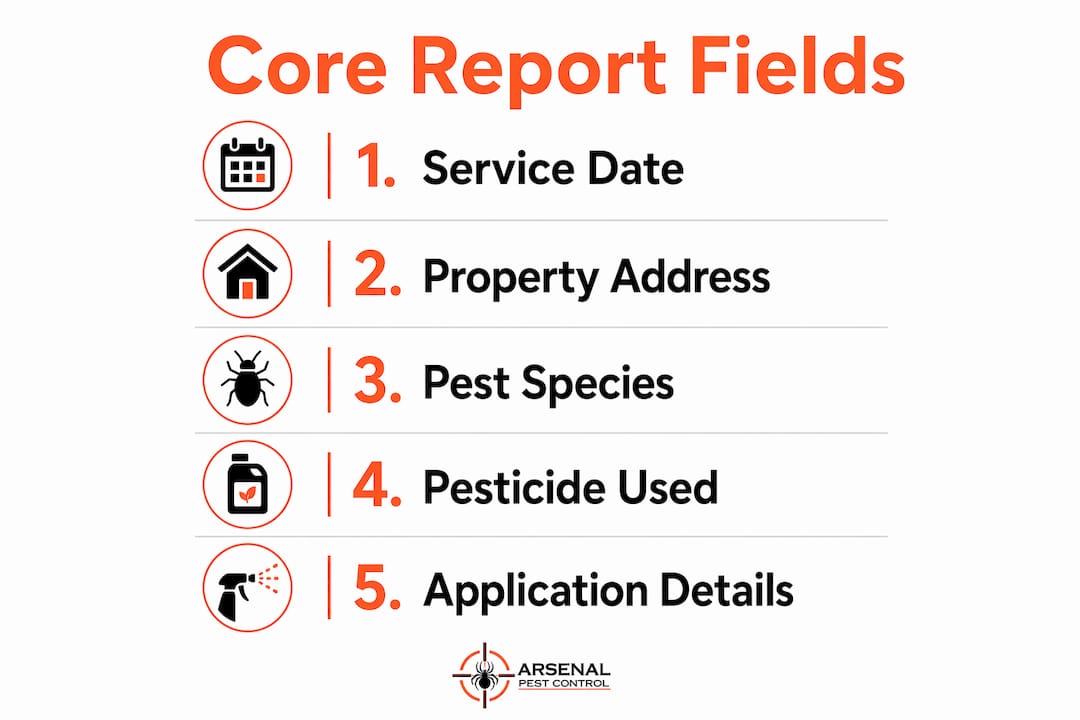
A standard report must include the service date and time, the full property address, and the target pest species identified during the visit. It must also list every pesticide product used by name, along with the EPA registration number and the amount applied. The technician’s name, license number, and supervising applicator information must appear as well.
These fields are not optional. Arizona regulations mandate each of these elements in every service record. A report missing any of them is incomplete and potentially non-compliant.
Inspection findings and recommendations
Beyond the treatment log, a thorough report documents what the technician actually observed. Comprehensive service reports should record pest species, the locations where activity was found, estimated quantity or severity, and any conducive conditions such as moisture intrusion, gaps in the foundation, or wood-to-soil contact.
The recommendations section is where many homeowners stop reading. Do not stop there. This section tells you what you need to fix or change to prevent the next infestation.
| Report Field | What It Tells You |
|---|---|
| Pest species identified | Which pests are present and their behavior patterns |
| Locations of activity | Where the infestation is concentrated on your property |
| Products used with EPA numbers | What chemicals were applied and their regulatory classification |
| Conducive conditions noted | Environmental factors that invite future pest problems |
| Technician certification details | Whether the applicator is licensed to perform the work |
| Recommendations | Corrective actions you need to take as the property owner |
Pro Tip: Check the pesticide signal words listed in your report. Arizona labels use “Caution,” “Warning,” and “Danger” to indicate toxicity levels. “Danger” products require the most protective measures during and after application, and your report should note any re-entry intervals.
How do you analyze pest activity and treatment effectiveness?
Pest control report analysis starts with reading the report as a narrative, not a checklist. Effective pest reports link pest evidence, location, and treatment products together to justify the control measures taken. If your report lists a pesticide application but shows no corresponding pest evidence, ask why that product was used in that location.
Reading pest identification and location data
The species name matters because different pests require different treatments and signal different risks. Bark scorpions in the garage mean something different than roof rats in the attic. The location data tells you whether the infestation is isolated or spreading. A single ant trail near the kitchen is a different problem than activity documented at the foundation, the garage, and two interior walls.
Understanding pest counts and trends over time
One report gives you a snapshot. Multiple reports give you a story. Trending pest activity data across visits is far more valuable than any single visit record for determining whether your pest program is working. If scorpion sightings documented in your reports drop from eight per visit to two over three months, the treatment is working. If counts stay flat or rise, something needs to change.
Here is a practical way to track your reports over time:
- Create a simple log with the date, pest species, count, and locations from each report.
- Note any new conducive conditions the technician flagged.
- Record which recommendations you completed and when.
- Compare counts for the same pest across at least three consecutive visits before drawing conclusions.
- Flag any visit where the report says only “service completed” with no findings detail.
That last point matters. Reports stating only “service completed” without documented findings are red flags. They undermine accountability and give you no basis for evaluating treatment effectiveness.
Why conducive conditions predict future problems
Environmental factors documented in reports often predict future infestations more reliably than current pest counts. A technician who notes standing water near your AC unit, mulch piled against your foundation, or a gap under your garage door is giving you a preview of next season’s problem. Fixing those conditions is often more effective than any chemical treatment alone.
Pro Tip: When you receive a report after each visit, read the conducive conditions section first. These are the items you can act on immediately, and they often cost nothing to fix.
What are the legal requirements for pest control reports in Arizona?
Arizona law sets clear rules for what pest control documentation must contain and how long it must be kept. These rules protect you as a property owner and give you grounds to challenge a provider who is not meeting professional standards.
Arizona law requires pest control businesses to retain all service records, inspection reports, and contracts for at least 3 years. That retention period means you can request records from past visits even if you have lost your own copies.
The governing framework falls under Arizona Revised Statutes Title 3, Chapter 20, and the administrative rules of the Arizona Department of Agriculture. Key requirements include:
- Mandatory report fields: Date, time, property address, pest identified, product name, EPA registration number, amount used, and applicator credentials.
- Technician certification: Every applicator must hold a valid Arizona pest control license. The report must identify the licensed individual who performed the work.
- Written recommendations: When a technician recommends corrective work, that recommendation must be provided in writing.
- Documented refusals: If you decline a recommended repair or treatment, that refusal must be documented in writing to protect both you and the provider from liability.
- Record retention: All service documentation must be kept for 3 years by the pest control business.
“Clear written recommendations and documentation of client refusals protect both homeowners and pest control providers from liability. This is a professional standard required in Arizona, not just a courtesy.”
You can verify your provider’s compliance by asking to see a sample service report before your first visit. A licensed, compliant provider will have no hesitation showing you what their documentation looks like.
One area where homeowners frequently get confused is the difference between a general pest inspection and a Wood-Destroying Organism inspection. A WDO inspection is a specialized report required for termite and wood-boring insect concerns. It is legally distinct from a standard service report and must be performed by a licensed pest professional. If you are buying or selling a home in Arizona, a WDO report is not optional.
Practical steps to act on your treatment report
Reviewing a report effectively takes about ten minutes. Most homeowners skip this step entirely. That is a mistake that costs money over time.
- Read the report the same day it is delivered. Findings are most actionable when the visit is fresh. If something is unclear, call the technician while the details are still in their memory.
- Verify all mandatory fields are present. Check for the technician’s license number, the EPA registration numbers for products used, and the service date and time. Missing fields are worth flagging.
- Address conducive conditions within two weeks. Seal gaps, fix leaks, move firewood away from the structure, and trim vegetation touching the roofline. These are the changes that reduce future pest pressure.
- Keep a physical or digital folder for all reports. Organize them by date. When you have three or more reports, you can start identifying trends. This record also matters if you ever need to file a complaint or make an insurance claim.
- Request written documentation of any declined recommendations. If you cannot afford a repair the technician recommended, ask them to note your refusal in the service record. This protects you legally and keeps the record accurate.
- Ask for a second opinion when reports are vague. If your reports consistently lack detail or the pest problem is not improving after several visits, request a re-inspection or consult a second licensed provider.
For property managers overseeing multiple units, seasonal pest control programs generate a large volume of reports. Building a simple spreadsheet that tracks pest activity by unit and date across all reports gives you a property-wide view that no single report can provide.
Pro Tip: Ask your pest control provider to email reports within 24 hours of each visit. A provider who cannot deliver timely documentation is a provider who may not be keeping compliant records.
Key Takeaways
A pest control treatment report is only useful if you read it critically, track it over time, and act on its recommendations.
| Point | Details |
|---|---|
| Know the required fields | Arizona law mandates pest ID, EPA product numbers, applicator credentials, and service date on every report. |
| Track trends, not snapshots | Compare pest counts and locations across multiple reports to judge whether treatment is working. |
| Act on conducive conditions | Environmental factors noted in reports predict future infestations and are often free to fix. |
| Understand your legal rights | Arizona requires 3-year record retention; you can request past service records from your provider. |
| Demand written recommendations | Corrective work and any refusals must be documented in writing under Arizona professional standards. |
What most homeowners miss when reading pest reports
Most homeowners read a pest control report the same way they read a receipt. They check that a service happened, glance at the total, and file it away. That approach leaves the most valuable information unread.
At Arsenal Pest Control, we have seen this pattern consistently across Queen Creek, Gilbert, and San Tan Valley. Homeowners call us frustrated that their pest problem has not improved after months of service. When we ask to see their previous reports, the pattern is almost always the same: conducive conditions were flagged repeatedly, recommendations were never acted on, and no one tracked whether pest counts were trending up or down.
The report is not the end of the service visit. It is the beginning of your role in the process. A good technician documents what they found and what they did. Your job is to read that documentation, fix what you can fix, and hold the provider accountable for results over time.
Wood-destroying organism reports deserve special attention here. Many homeowners assume their termite inspection is covered by a standard service visit. It is not. A WDO report is a separate, specialized document. Confusing the two can leave serious structural damage undetected until it becomes expensive.
The best pest control relationship is one where the report drives the conversation. Bring your last three reports to your next service visit. Ask your technician to walk through the trends with you. A provider who cannot do that is not managing your pest problem. They are just showing up.
— Arsenal Pest Control
Arsenal Pest Control: clear reports after every visit
Arsenal Pest Control delivers detailed service reports after every visit to homes and properties across Queen Creek, San Tan Valley, Florence, Gilbert, Chandler, Mesa, and Apache Junction.
Every report documents pest findings, products used with EPA registration numbers, conducive conditions, and written recommendations. Arsenal Pest Control follows all Arizona Department of Agriculture documentation requirements, and our team is available to walk you through any report after your service. You never need to wonder what was done or why. If you are ready to work with a licensed provider who treats documentation as seriously as the treatment itself, view our pest control services or reach out to schedule your first visit with no long-term contract required.
FAQ
What must a pest control treatment report include in Arizona?
Arizona law requires every service report to include the date and time, property address, pest species identified, pesticide product names and EPA registration numbers, amounts applied, and the technician’s license and certification details. Reports missing these fields do not meet state standards.
How long should I keep my pest control reports?
Arizona law requires pest control businesses to retain service records for at least 3 years. You should keep your own copies for the same period, especially if you plan to sell the property or need to document a recurring pest problem.
What is the difference between a pest inspection report and a WDO report?
A standard pest inspection report covers general pest activity and treatment. A Wood-Destroying Organism report is a specialized document covering termites and wood-boring insects, and it must be performed by a licensed pest professional. They are legally distinct documents.
How do I know if my pest control treatment is actually working?
Compare pest counts and activity locations across at least three consecutive service reports. If documented pest activity is declining over time, the treatment is working. Flat or rising counts after multiple visits signal that the approach needs to change.
What should I do if my pest control report is vague or incomplete?
Contact your provider immediately and request a detailed re-inspection. A report that says only “service completed” with no findings or product details is a red flag. Under Arizona regulations, compliant documentation is a professional requirement, not an optional extra.
Recommended
- Arizona Ant Infestation Identification Guide for Homeowners – Arsenal Pest Control
- What Is Quarterly Pest Service? A Homeowner’s Guide – Arsenal Pest Control
- Pest Control Services Mesa AZ | Arsenal Pest Control
- Services – Arsenal Exterminating Pest Control Services
