


The fastest way to reduce scorpion risk right now is to combine three things: seal the obvious entry points, remove harborage from around your foundation, and start monitoring with a UV black light. Pesticides help, but they won’t solve the problem on their own. Here’s what to do immediately.
Do this today:
- Stay calm and keep kids and pets away from any visible scorpion. Never pick one up bare-handed.
- At night, use a UV black light to locate scorpions. Pick them up with long tongs or trap them under a glass jar.
- Install or adjust door sweeps on every exterior door, including the garage.
- Move woodpiles, rock piles, and cardboard boxes away from the house.
- Place glue/sticky traps in the garage, along baseboards, and near entry points.
- If sightings continue indoors after a week of these steps, call a licensed technician.
This approach follows Integrated Pest Management (IPM) principles: exclusion and habitat modification first, targeted treatments second, and professional help when the problem exceeds what DIY can handle. Arsenal Pest Control offers licensed scorpion control, sealing, and recurring service plans for Queen Creek and the surrounding East Valley communities.
Table of Contents
- How do you know if you have a scorpion problem?
- What to do the moment you spot a scorpion
- How to seal your home and yard so scorpions can’t get in
- Which products actually work, and what are their limits?
- How to monitor scorpion activity and know if it’s working
- When should you call a licensed scorpion control service?
- Why pesticides alone won’t solve a scorpion problem
- Key Takeaways
- The part most guides won’t tell you
- Ready to stop finding scorpions in your home?
- Useful sources and further reading
How do you know if you have a scorpion problem?
Most homeowners in the desert Southwest already know scorpions are nearby. The real question is whether they’re getting inside, and which species you’re dealing with.

Physical ID: Scorpions have eight legs, two large pincers (pedipalps), and a segmented tail that curves upward and ends in a stinger. Adults vary in size depending on species. The Arizona bark scorpion (Centruroides sculpturatus) is the medically important species. It is slender, pale tan to yellowish-brown, and of moderate size. Unlike most scorpions, it can climb walls and hide in tight vertical crevices, which is why it ends up inside homes so often.
Signs of increasing activity:
- Repeated nighttime sightings, especially near weep holes, door frames, or block fences
- Scorpions found inside shoes, clothing, or bedding
- Presence of crickets or cockroaches (scorpions follow their food)
- Scorpions on or near hollow-block walls or under landscaping rocks
Seasonal patterns: Activity peaks from April through October in Arizona, with a notable surge after monsoon rains in July and August. Scorpions are most mobile on warm nights above 70°F. They don’t disappear in winter; they slow down and shelter deeper in cracks and wall voids.
The Arizona bark scorpion is the only species in the United States considered medically significant. Its venom can cause severe pain, numbness, and in vulnerable individuals (young children, elderly adults, or those with certain health conditions), more serious systemic symptoms. Keep the Arizona Poison Control Center number (1-800-222-1222) saved in your phone if you live in scorpion country.
Pro Tip: Take a clear photo of any scorpion you find before removing it. A photo helps a pest control technician confirm the species and tailor the treatment approach.

What to do the moment you spot a scorpion
Safety first, always. A scorpion on the floor is not an emergency, but it does require a calm, deliberate response.
- Clear the area. Move children and pets to another room before doing anything else.
- Don’t touch it. Even a scorpion that looks dead can sting reflexively.
- Use a UV black light at night. Scorpions fluoresce bright green under UV light, making them easy to spot from several feet away. This is the single most effective tool for locating them in low-light conditions.
- Capture or kill from a distance. Slide a glass jar over the scorpion and slip a piece of cardboard underneath to seal it. Long kitchen tongs work for picking it up. In high-risk households (young children, immunocompromised family members), killing it on contact with a heavy shoe or tool is a reasonable choice.
- Check the immediate area. Where there’s one scorpion, there may be others. Sweep the room with your UV light before declaring it clear.
- Shake out shoes, clothing, and bedding in any room where a scorpion was found. Bark scorpions especially like to hide in fabric folds and tight spaces.
University of Arizona IPM research confirms that manual collection with tongs after dark is often more effective at reducing local scorpion populations than a single spray application. Repeated nighttime collections during the active season can meaningfully cut down the number of scorpions living near your home.
When to seek medical care for a sting: Call Poison Control (1-800-222-1222) immediately after any sting. Go to the emergency room if you see difficulty swallowing, muscle twitching, blurred vision, drooling, or breathing problems. Children under five and adults over 65 should be evaluated in person even for mild symptoms.
How to seal your home and yard so scorpions can’t get in
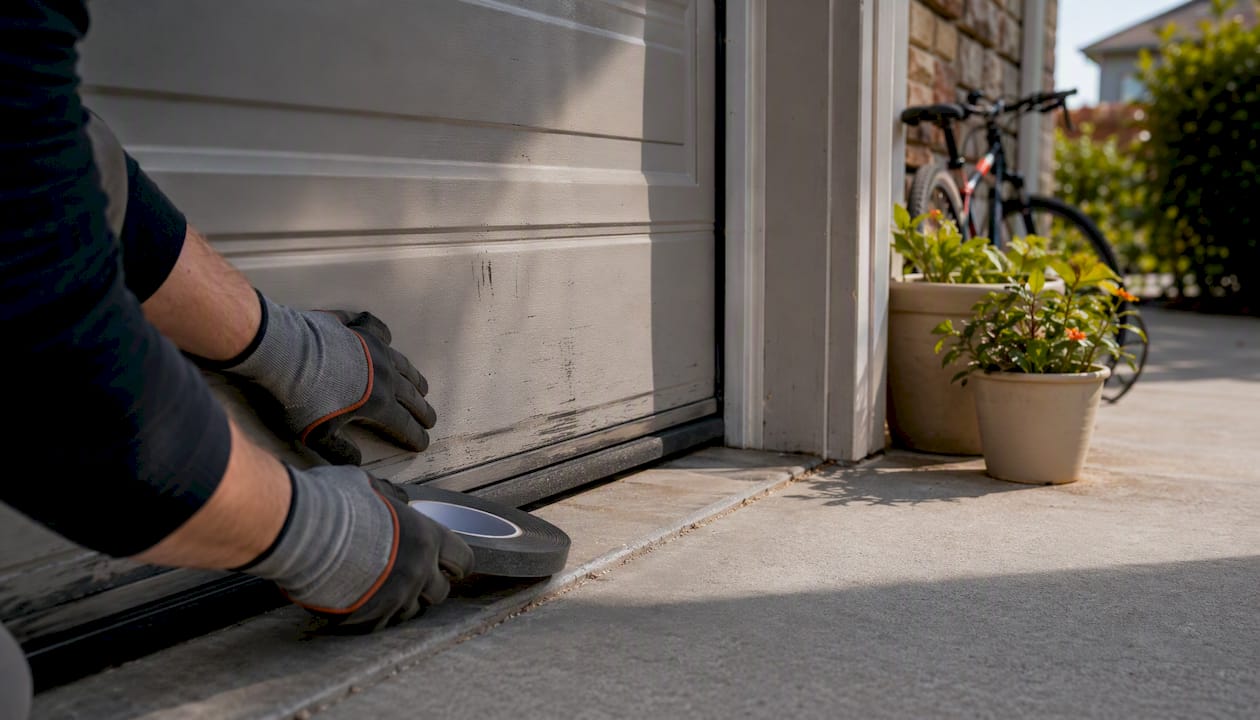
Exclusion is the single most durable scorpion control method available. A scorpion can squeeze through a gap as small as 1/16 of an inch, roughly the thickness of a credit card. That’s a humbling standard, but it’s achievable with the right materials and a systematic approach.
Start with the yard:
- Remove woodpiles, rock piles, and debris from within 10 feet of the foundation.
- Trim tree branches and shrubs so they don’t touch the walls or roofline.
- Reduce mulch depth near the foundation; replace with gravel where possible.
- Adjust drip irrigation to water less frequently and earlier in the day, so soil dries out before nightfall.
- Remove ground cover plants directly against the house; they create cool, damp harborage.
Seal the structure:
- Install door sweeps on all exterior doors, including the door between the garage and living space.
- Add weatherstripping to door frames and replace any that’s cracked or compressed.
- Caulk around all pipe penetrations, electrical conduit, and HVAC lines entering the house.
- Screen weep holes with coarse steel mesh and cap the tops of hollow-block walls.
- Replace or repair torn window and door screens.
The two spots most homeowners miss: The weep screed at the base of stucco walls and small utility penetration gaps. Bark scorpions use weep screed as a primary entry point, and most DIY sealers walk right past it. Run your hand along the base of your stucco exterior and feel for gaps; seal them with a flexible caulk rated for exterior use.
Garage specifics: The garage is the most common indoor scorpion entry point. Check that the bottom seal on the garage door makes full contact with the floor. Store firewood off the ground and away from the garage wall. Elevate trash cans on a rack so scorpions can’t shelter underneath.
Pro Tip: Do your exterior inspection at night with a UV black light. You’ll see exactly where scorpions are entering and resting, which tells you precisely where to caulk, seal, and treat. A daytime inspection misses most of the story.
Which products actually work, and what are their limits?
No single product eliminates scorpions. Every effective control program combines multiple tools, and understanding what each one does (and doesn’t do) saves you money and frustration.
Product categories:
- Perimeter residual insecticides (pyrethroids like bifenthrin or cypermethrin): Applied around the foundation, these create a treated zone that kills scorpions crossing it. Effective when reapplied regularly, but scorpions’ raised body posture and waxy exoskeleton reduce contact with treated surfaces.
- Insecticidal dusts (such as Delta Dust or diatomaceous earth): Applied inside wall voids, electrical boxes, and hollow-block cores. Dusts reach areas sprays can’t and remain active longer in dry conditions. Diatomaceous earth is a lower-toxicity option that damages the exoskeleton over time.
- Glue/sticky traps: Placed along baseboards, in garages, and near entry points. Traps don’t control populations on their own, but they’re the best monitoring tool available. A spike in trap counts tells you where activity is concentrated.
- UV black light: Not a pesticide, but arguably the most useful tool in the kit. Scorpions fluoresce under UV, making nighttime detection and manual removal practical.
Scorpions’ raised stance and waxy exoskeleton mean surface sprays are less reliable than they are for most other insects. Mechanical exclusion and void dusting are preferred for persistent infestations, particularly in hollow-block wall construction common in Arizona.
Safety for kids and pets: Always follow label instructions. Keep children and pets out of treated areas until surfaces are dry. For households with young children or sensitive pets, ask about family-safe treatment options before any application. Avoid indoor broadcast sprays without adequate ventilation.
| Characteristic | DIY Treatment | Professional Service |
|---|---|---|
| Typical cost | — | $100–$500 one-time; $35–$60/month recurring |
| Duration of protection | Weeks (varies by product) | several weeks per visit with professional-grade residuals |
| Void and wall treatment | Limited access | Insecticidal dust in voids and block cores |
| Exclusion work | Homeowner-performed | Minor sealing included; comprehensive sealing $300–$1,000 |
| Best use case | Low-pressure areas, ongoing maintenance | Recurring sightings, bark scorpion presence, structural harborage |
How to monitor scorpion activity and know if it’s working
Monitoring tells you whether your efforts are moving in the right direction. Without it, you’re guessing.
Nighttime UV sweeps:
- Go out between 8 and 11 p.m. during warm months with a UV black light.
- Walk the perimeter of the house slowly, checking the base of walls, block fences, and landscaping.
- Record what you find: how many scorpions, where, and near which features (weep holes, gaps, irrigation heads).
- Repeat this 3–4 times during the active season; repeated collections can significantly reduce localized populations.
Glue trap placement:
- Garage corners and along the garage door threshold
- Behind the refrigerator, washer, and dryer
- Along interior baseboards in bathrooms and laundry rooms
- Along the exterior base of block fences
Traps won’t eliminate a population, but a sudden increase in catches signals a new entry point or a harborage you haven’t addressed yet.
Monitoring schedule:
- Weeks 1–4 after initial remediation: weekly nighttime UV sweeps and trap checks
- Month 2 onward: monthly checks if counts are declining
- Escalate to professional help if indoor sightings continue after four weeks of consistent exclusion and monitoring
When should you call a licensed scorpion control service?
DIY steps handle low-pressure situations well. These are the signs that a professional is the smarter call:
- You’re finding scorpions inside the living space more than once a week.
- You’ve confirmed or strongly suspect Arizona bark scorpions.
- Your home has hollow-block wall construction and interior sightings persist despite sealing.
- A family member is medically vulnerable (young child, elderly adult, immunocompromised).
- You’ve done the exclusion work and sightings haven’t declined after 4–6 weeks.
What a professional visit typically includes:
- UV inspection of the interior and exterior at night or in low-light conditions
- Perimeter residual spray along the foundation and entry points
- Interior baseboard and closet treatments
- Insecticidal dust applied to wall voids, hollow-block cores, and electrical boxes
- Minor exclusion work (door sweeps, caulking of visible gaps) and written recommendations for larger sealing projects
- Follow-up visit scheduling
Professional scorpion treatment is most effective as an ongoing program in high-pressure areas. A single one-time treatment reduces immediate pressure, but monthly service plans are what consistently keep bark scorpion activity at manageable levels in Arizona’s East Valley.
For recurring or severe infestations, Arsenal Pest Control’s scorpion service covers Queen Creek, San Tan Valley, Gilbert, Chandler, Mesa, Apache Junction, and surrounding communities. Look for these trust signals in any licensed provider: state pest control license, clear written scope of work, warranty or follow-up visit policy, and explicit confirmation of family- and pet-safe product options.
Why pesticides alone won’t solve a scorpion problem
This is the part most homeowners learn the hard way after spending money on spray cans.
University of Arizona Cooperative Extension research is direct on this point: scorpions cannot be managed effectively with pesticides alone. The recommended approach is IPM, which combines habitat modification, exclusion, monitoring, and targeted chemical treatments as a supporting tactic, not the primary one.
The biology explains why. Scorpions walk with their bodies raised off the ground, which limits contact with treated surfaces. Their waxy exoskeleton further reduces absorption of contact insecticides. And their preferred hiding spots, inside hollow-block wall cores, weep screed channels, and wall voids, are places a perimeter spray simply doesn’t reach.
Hollow-block walls may harbor scorpions vertically throughout their entire height. Treating only the exterior perimeter without addressing block cores or mortar joints leaves a persistent internal source that continues sending scorpions indoors regardless of how often the outside is sprayed.
The practical implication: if you spray the perimeter and skip the sealing, you’re managing the symptom. The scorpions living in your block fence or wall voids will keep coming. Sealing gaps to 1/16-inch precision, dusting voids, and removing harborage are what actually interrupt the cycle. Pesticides then serve as a backup layer, not the foundation of the plan.
University of Arizona IPM guidance frames it plainly: attempting total eradication with heavy chemicals would require levels of pesticide use that are both unhealthy and, in many cases, illegal. The sustainable answer is exclusion and habitat modification, with treatments used precisely and selectively.
Key Takeaways
Sealing gaps to 1/16-inch precision combined with consistent UV monitoring and habitat modification is the most effective long-term strategy for keeping scorpions out of your home.
| Point | Details |
|---|---|
| Exclusion is the priority | Seal gaps as small as 1/16 inch, including weep screed, pipe penetrations, and hollow-block wall tops. |
| UV monitoring works | Nighttime sweeps between 8–11 p.m. and repeated collections 3–4 times per season reduce local populations measurably. |
| Pesticides support, not lead | Perimeter sprays and void dusts work best as part of IPM, not as a standalone fix. |
| Know when to escalate | Recurring indoor sightings, bark scorpion presence, or vulnerable family members are clear triggers to call a licensed technician. |
| Arsenal Pest Control | Provides licensed scorpion control, UV inspection, void dusting, and recurring service plans across Queen Creek and the East Valley. |
Pro Tip: The single highest-impact action most homeowners skip is sealing the weep screed at the base of stucco walls. Do that one thing and you’ll close the most-used scorpion entry point in Arizona construction.
The part most guides won’t tell you
The honest reality of scorpion control in the desert Southwest is that you’re not trying to eliminate scorpions from the planet. You’re trying to make your home a place they can’t get into and don’t want to be near. That’s a winnable goal, but it requires accepting that this is ongoing maintenance, not a one-time fix.
The homeowners who see the biggest improvement are the ones who treat exclusion like a home maintenance task, the same way they’d check smoke detector batteries or clean gutters. They do a UV sweep every few weeks during summer, they re-caulk after monsoon season shifts the soil, and they call Arsenal Pest Control when they see a trend reversing.
The ones who stay frustrated are usually chasing scorpions with spray cans and skipping the sealing. A perimeter spray without exclusion is like mopping the floor with the faucet still running.
Realistic timeline: immediate actions (door sweeps, removing harborage) reduce risk within days. Proper exclusion work takes a weekend to a few weeks depending on the property. With monthly service or repeated exclusion, most homeowners in high-pressure areas see a measurable decline in sightings within 1–3 months. That’s not a guarantee, but it’s what consistent, layered IPM actually delivers.
Ready to stop finding scorpions in your home?
Arsenal Pest Control gives Queen Creek and East Valley homeowners something DIY products can’t: a licensed technician who inspects with UV at night, treats wall voids and hollow-block cores with professional-grade dust, and seals the entry points that most homeowners miss entirely, including weep screed, utility penetrations, and garage thresholds.

No long-term contracts. Family- and pet-safe treatment options. Monthly and one-time plans available depending on your pressure level. Arsenal serves Queen Creek, San Tan Valley, Gilbert, Chandler, Mesa, Apache Junction, Florence, and surrounding communities. Typical costs are $100–$500 for a one-time treatment, $35–$60 per month for recurring service, and $300–$1,000 for comprehensive sealing, according to 2026 industry pricing.
Schedule a scorpion inspection or browse the full range of residential and commercial services to find the plan that fits your property.
Useful sources and further reading
These are the primary sources cited throughout this guide, organized by use case.
For DIY steps and IPM guidance (start here):
- Scorpions (University of Arizona Cooperative Extension): The most thorough extension publication on scorpion biology, exclusion, and IPM for Arizona homeowners. Best for understanding why each control method works.
- Living with and Managing Scorpions (University of Arizona IPM Newsletter): Practical guidance on UV night collections and population reduction; recommended for anyone setting up a monitoring routine.
- Scorpions (University of Arizona Public Health IPM): Covers exclusion checklists, habitat modification, and the case for pest-proofing over chemical eradication.
- Managing Scorpions (University of Arizona IPM Newsletter, 2018): Explains why total eradication is neither realistic nor safe, and frames the sustainable management approach.
For sealing and entry-point specifics:
- Sealing Scorpion Entry Points (ScorpionAlert): Detailed guidance on weep screed, hollow-block walls, and the 1/16-inch sealing standard.
For hiring a professional and understanding costs:
- Scorpion Exterminator Cost: 2026 Pricing Guide: Covers typical cost ranges for one-time treatments ($100–$500), monthly plans ($35–$60/visit), and exclusion work ($300–$1,000).
For medical emergencies: Call the Arizona Poison Control Center at 1-800-222-1222 immediately after any scorpion sting. Go to the emergency room for any neurological symptoms, difficulty breathing, or if the person stung is a young child.
Recommended
- Commercial Scorpion Treatment: A Facility Manager’s Guide – Arsenal Pest Control
- Scorpion Control in Queen Creek, AZ | Scorpion Exterminator
- Spider Web Removal: What Homeowners Need to Know – Arsenal Pest Control
- Fire Ant Control for Homeowners: A Practical Yard Plan – Arsenal Pest Control
