


What is commercial scorpion treatment?
Commercial scorpion treatment is a professional pest management service built around Integrated Pest Management (IPM), combining physical exclusion, habitat modification, and targeted pesticide applications to reduce scorpion activity in business environments. Unlike a one-time spray, it is a structured, ongoing program designed to make your facility inhospitable to scorpions rather than chase an eradication goal that experts at the University of Arizona describe as impractical without excessive and illegal chemical use.
The core difference from residential treatment is scope and accountability. Commercial properties face stricter regulatory requirements, higher liability exposure, and more complex building footprints. A proper commercial program includes:
- Building exclusion: Sealing cracks, installing door sweeps, and weatherstripping all exterior openings
- Habitat modification: Removing debris, trimming vegetation away from the structure, and managing outdoor lighting
- Targeted pesticide use: Applying low-impact, residual insecticides at the right time and location
- Ongoing monitoring: Glue board traps, UV black light inspections, and scheduled follow-up visits
- Documentation and compliance: Keeping treatment records that satisfy state pesticide regulations and insurance requirements
The goal is not zero scorpions on the planet. The goal is zero scorpions inside your building.
How professional scorpion treatments are performed
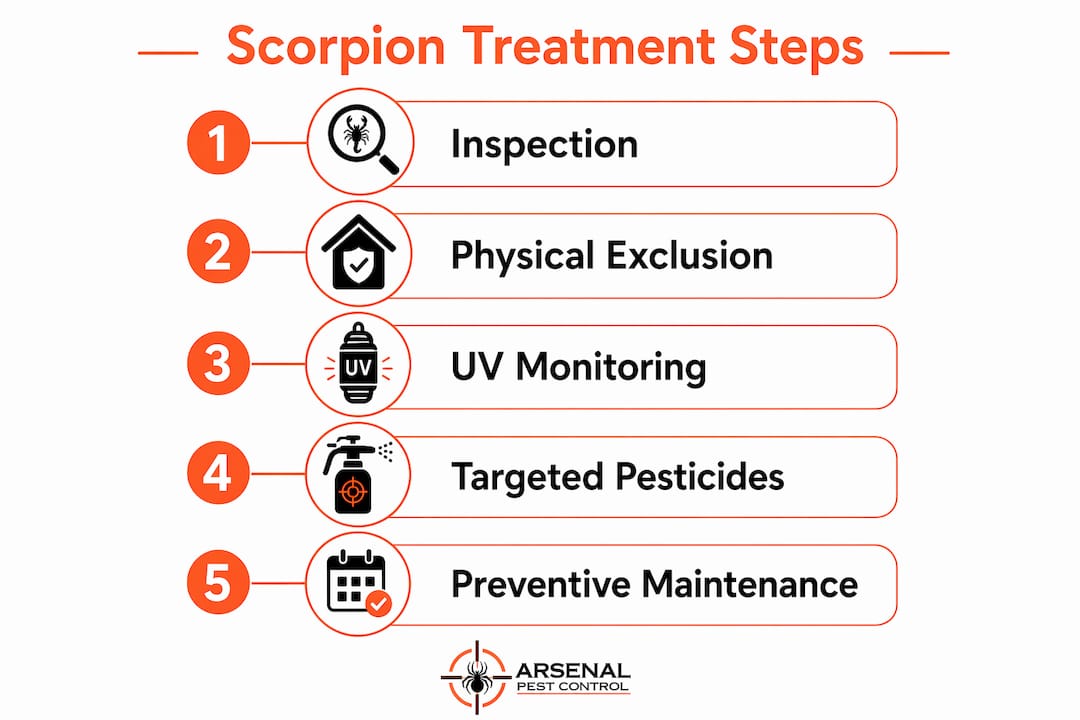
A trained technician follows a repeatable process, not a single spray-and-leave visit. Here is what a thorough commercial treatment looks like from start to finish:
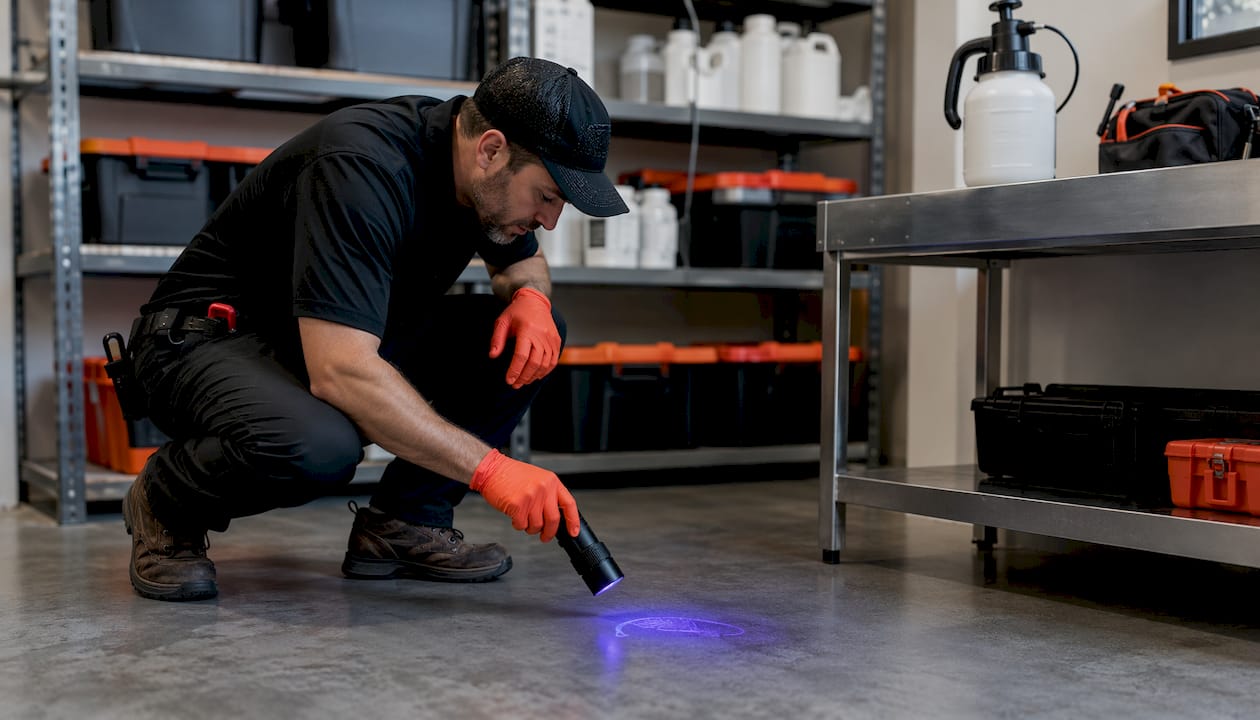
- Initial inspection: The technician walks the entire perimeter and interior, paying close attention to utility penetrations, loading dock doors, and storage areas. UV black light inspections at night are particularly effective because scorpions fluoresce under ultraviolet light, making them easy to spot in the dark.
- Physical exclusion: Gaps around pipes, conduits, and exterior doors get sealed with steel wool, caulk, or door sweeps. This step alone does more to prevent re-entry than any chemical application.
- Habitat modification: Debris piles, wood stacks, and dense ground cover near the building are removed or relocated. Vegetation is trimmed back from walls and rooflines, since tree branches give scorpions a direct path to upper floors.
- Light modification: Switching exterior fixtures to yellow-spectrum bulbs reduces insect attraction near the building, cutting the food supply that draws scorpions in.
- Pesticide application: Wettable powder and microencapsulated pyrethroid formulations, such as deltamethrin, bifenthrin, or lambda-cyhalothrin, offer the best residual activity. Applications are most effective at night when scorpions are actively foraging, and should be restricted to outdoor areas per label directions.
- Manual collection: Technicians use UV lights with smooth-sided containers to collect and remove scorpions on-site. Conducting this three to four times per season can significantly reduce local populations, often more reliably than chemical treatment alone.
- Follow-up monitoring: Glue board traps placed in harborage zones track population pressure between visits and flag areas that need additional attention.
Pro Tip: Ask your pest control provider to schedule at least one UV black light collection visit per month during peak season (April through October in the desert southwest). Manual removal combined with exclusion outperforms chemical-only programs in most documented cases.
What scorpion infestations actually cost your business
The risks go well beyond a startled employee. Scorpion problems in commercial settings create layered consequences that compound quickly.
- Health and liability: The Arizona bark scorpion is the most venomous scorpion in the United States, and stings can require emergency medical treatment. A sting on your property can trigger workers’ compensation claims, OSHA recordable incidents, or personal injury lawsuits.
- Operational disruption: Discovering scorpions in a warehouse, food processing line, or hotel room forces immediate work stoppages, room closures, or product holds.
- Reputation damage: A guest photographing a scorpion in a hotel bathroom and posting it online is a customer service crisis. In the hospitality sector, one incident can generate reviews that outlast the infestation itself.
- Secondary pest pressure: Scorpions follow their food. A facility with high cricket or cockroach activity will attract scorpions. Solving the scorpion problem without addressing prey insects is a temporary fix.
- Regulatory consequences: Food-handling facilities face FDA and state health department inspections. A documented scorpion sighting during an audit can trigger a corrective action plan or temporary closure.
Which industries face the highest scorpion risk?
Geography is the biggest factor, but building type and operations matter just as much. Facilities in Arizona, New Mexico, Nevada, and other arid southwestern states carry the highest baseline risk. Within those regions, certain industries are consistently more vulnerable:
- Warehousing and distribution: Large footprints, frequent dock door openings, and pallet storage create ideal harborage conditions.
- Food processing and commercial kitchens: Moisture, warmth, and abundant prey insects make these facilities attractive. For commercial kitchen pest prevention, exclusion around floor drains and utility lines is especially critical.
- Hospitality: Hotels and resorts near desert terrain deal with scorpions year-round, particularly in ground-floor rooms and landscaped courtyards.
- Light manufacturing: Concrete slab construction with numerous conduit penetrations gives scorpions easy entry and plentiful hiding spots under equipment.
- Schools and childcare facilities: Children are at higher risk of severe reactions to stings, making proactive treatment a safety priority rather than a comfort measure.
- Outdoor storage and construction sites: Temporary structures, material piles, and disturbed soil are prime scorpion habitat.
Any facility that stores materials outdoors, sits adjacent to desert terrain, or has older construction with unsealed utility penetrations should treat scorpion control as a standing line item, not a reactive expense.
How to identify scorpions in your facility
Early detection prevents a minor problem from becoming a full infestation. Knowing what to look for and where to look cuts response time considerably.
- Physical appearance: The Arizona bark scorpion is slender, tan to light brown, and typically 2–3 inches long. It has eight legs, two clawed pincers (pedipalps), and a segmented tail that curves upward with a stinger at the tip. Stripe-tailed scorpions are bulkier with wider tails and are generally less dangerous.
- Where to inspect: Focus on cracks in walls and floors, under pallets and equipment, inside cardboard boxes, around pipe chases, and in any area with low foot traffic. Scorpions are flat enough to squeeze through gaps as thin as a credit card.
- UV black light detection: Scorpions glow bright green under ultraviolet light. A nighttime walk with a UV flashlight turns a difficult visual search into a straightforward one.
- Signs of activity: Shed exoskeletons (molts) near harborage areas, dead insects concentrated in one zone, or employees reporting stings in a specific part of the building all point to an active population nearby.
- Glue board traps: Place them along walls and in corners of storage areas. Captures tell you exactly where scorpions are traveling and help your technician target treatments accurately.
How to get professional commercial scorpion treatment help
Finding the right provider matters as much as the treatment itself. Here is how to move from problem to solution efficiently:
- Verify credentials: Look for technicians certified through QualityPro, the National Pest Management Association’s professional certification program. Involvement of a Board Certified Entomologist signals a company that applies science, not just product.
- Request a site inspection: A reputable provider will walk your facility before quoting. Any company that quotes over the phone without seeing the building is guessing.
- Ask about the IPM approach: The right answer involves exclusion, habitat modification, and monitoring, not just a spray schedule. If the proposal is chemical-only, keep looking.
- Prepare the facility: Before the first treatment, clear clutter from perimeter walls, move stored materials off the ground, and identify all known entry points. The more access the technician has, the more thorough the inspection.
- Establish a service agreement: Commercial scorpion control requires regular visits, especially during peak season. Confirm the frequency of follow-up treatments and what triggers an emergency call-back.
- Review documentation: Your provider should supply written treatment records, product labels, and Safety Data Sheets. These are not optional for regulated industries.
For commercial pest exclusion strategies that go beyond scorpions, a facility-wide exclusion audit is a smart starting point.
How effective and safe are different treatment methods?
No single method eliminates scorpions on its own. The evidence points clearly toward layered approaches.
Physical exclusion is the most reliable long-term control. Sealing entry points stops scorpions before they get inside, and the effect is permanent once done correctly.
UV black light collection performed three to four times per season can reduce localized populations more effectively than chemical applications alone. It requires no pesticide and carries no residue risk, making it ideal for food-handling areas.
Fourth-generation pyrethroids (deltamethrin, bifenthrin, lambda-cyhalothrin) provide measurable suppression when applied as wettable powders or microencapsulated formulations outdoors at night. The catch is scorpion behavior: when scorpions encounter treated surfaces, they exhibit “stilting,” walking on the tips of their legs to minimize pesticide contact. This reduces efficacy and is exactly why chemical-only programs underperform.
Coconut fatty acid repellents represent a promising alternative. NMSU research found these repellents can protect premises from invasion for at least one week, triggering avoidance behavior without heavy synthetic insecticide use. They are particularly useful in sensitive environments like schools or food facilities.
Safety-wise, restricting pesticide applications to outdoor areas and following label directions keeps risk to occupants minimal. For additional pest control safety guidance, reviewing best practices for occupied commercial spaces is worthwhile before any treatment begins.
Preventive measures that actually keep scorpions out
Prevention is cheaper than treatment, and most of it comes down to consistent facility maintenance.
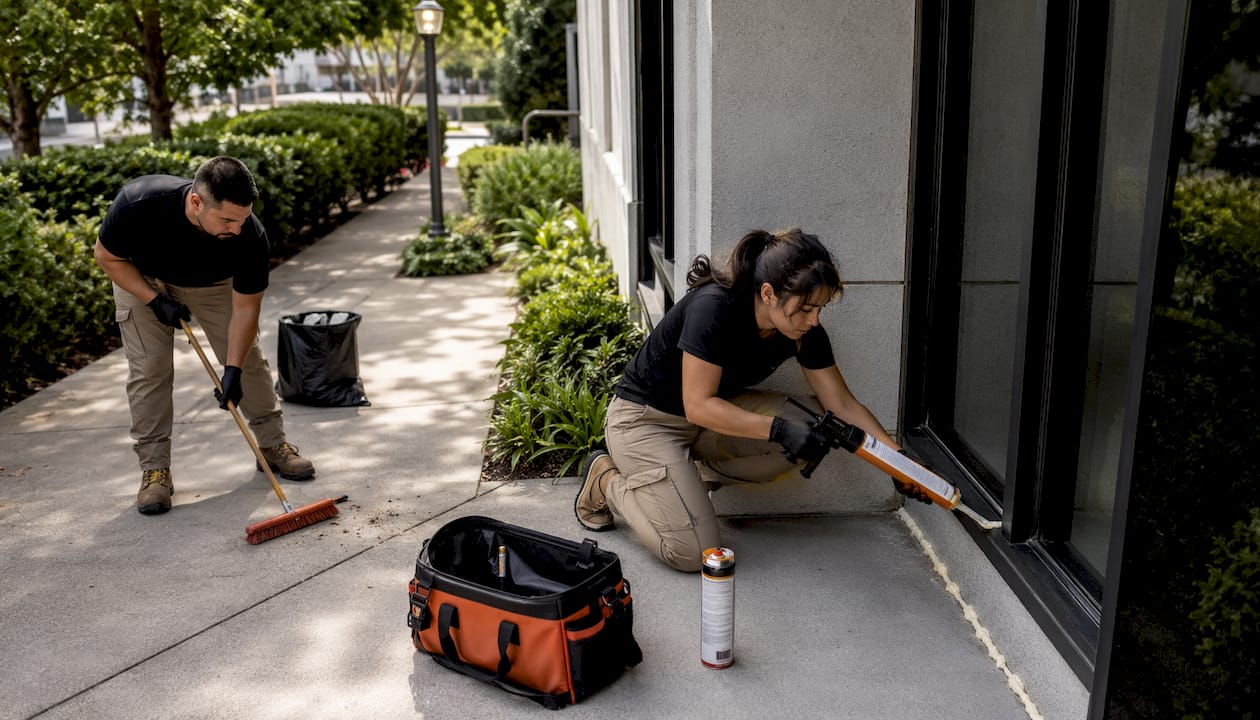
Seal every gap larger than a credit card on the building exterior. That means pipe penetrations, conduit entries, expansion joints, and the bottom edges of loading dock doors. Install tight-fitting door sweeps on all exterior doors and check them quarterly for wear.
Keep the perimeter clean. Removing debris, wood piles, and clutter from within several feet of the building eliminates the harborage scorpions need to stage before entering. Trim all vegetation, including tree branches, away from walls and rooflines.
Manage your lighting. Yellow-spectrum or sodium vapor exterior bulbs attract fewer insects than standard white or blue-white LEDs, which directly reduces the prey population that draws scorpions to your building at night.
Address prey insects proactively. Crickets are a primary food source for bark scorpions. A facility with an active cricket population is essentially a scorpion buffet. Treating for prey insects as part of your regular pest program removes a key attractant.
Regulations and compliance in commercial pest control
Commercial pest control operates under a layered regulatory framework that facility managers need to understand before signing a service agreement.
At the federal level, all pesticide products must be registered with the EPA under the Federal Insecticide, Fungicide, and Rodenticide Act (FIFRA). Applicators must follow label directions exactly, and the label is a legal document. Applying a product in a manner inconsistent with its label is a federal violation.
State licensing requirements vary, but every state requires commercial pesticide applicators to hold a current license in the appropriate category. In Arizona, the Office of Pest Management (OPM) regulates all commercial pest control activity and requires licensed applicators for any commercial treatment.
For regulated industries, additional layers apply. Food processing facilities must comply with FDA Food Safety Modernization Act (FSMA) requirements, which include documentation of pest control activities as part of a written food safety plan. Schools and childcare facilities in many states must follow specific IPM policies before any pesticide application.
Ask your provider for proof of licensure, insurance, and current pesticide applicator certifications before work begins. A reputable company will provide these without hesitation.
What commercial scorpion treatment costs
Pricing varies based on facility size, infestation severity, service frequency, and region. There is no universal flat rate, but understanding the cost structure helps you budget accurately.
Most commercial programs are priced on a per-visit or monthly service basis, with initial treatment costs higher than recurring visits due to the time required for inspection, exclusion work, and first-application setup. Larger facilities with complex footprints, multiple access points, or active infestations will cost more to treat than a single-story office building.
The most cost-effective approach is a preventive service agreement rather than reactive treatment. Waiting until scorpions are visible inside the building means the infestation is already established, and remediation takes longer and costs more than ongoing prevention.
Factor in the indirect costs too. A single workers’ compensation claim from a sting, or a failed health inspection tied to a pest sighting, will exceed the annual cost of a professional service contract by a wide margin. Budget scorpion control as risk management, not just pest control.
The IPM approach: why it outperforms chemical-only programs
Integrated Pest Management is the professional standard for commercial scorpion control because it addresses the conditions that allow scorpions to thrive, not just the scorpions themselves.
Between 2005 and 2015, 185,000 scorpion stings were reported in the United States, with 68% occurring in Arizona. That figure reflects why facilities in the desert southwest cannot treat scorpion control as a seasonal afterthought.
Key Stat: 185,000 US scorpion stings were recorded from 2005–2015, with Arizona accounting for 68% of cases, underscoring the public health urgency for commercial facilities in the region.
A well-structured IPM program for commercial scorpion control includes:
- Exclusion: The foundation. No chemical program compensates for an unsealed building.
- Habitat modification: Removing harborage and food sources reduces population pressure from the outside in.
- Monitoring: Glue boards and scheduled UV inspections track activity and measure program effectiveness over time.
- Selective pesticide use: Targeted outdoor applications of residual pyrethroids, timed for nighttime activity, as one component of a broader program, not the whole program.
- Ongoing partnership: Scorpion control requires consistent monitoring and communication between your facility team and your pest control provider to adapt treatments as conditions change.
The shift facility managers need to make is from “eradicate” to “manage.” Complete eradication is not a realistic or safe goal. A well-maintained IPM program keeps scorpions outside where they belong, protects your occupants, and keeps you compliant.
Ready to protect your facility?
Arsenal Pest Control serves commercial properties across Queen Creek, San Tan Valley, Gilbert, Chandler, Mesa, Apache Junction, Florence, and surrounding Arizona communities. Our technicians are trained in IPM-based scorpion extermination services built specifically for commercial environments, with no long-term contracts and environmentally responsible treatment methods. View our full range of commercial pest control services or contact us to schedule a facility inspection.
Key Takeaways
Commercial scorpion treatment works because it combines physical exclusion, habitat modification, and selective pesticide use within an ongoing IPM program, not because of any single chemical application.
| Point | Details |
|---|---|
| IPM outperforms chemicals alone | Exclusion and habitat modification are more effective than pesticide-only programs for long-term scorpion control. |
| UV black light collection works | Performing manual collection 3–4 times per season can reduce local populations more reliably than spraying. |
| Stilting reduces pesticide efficacy | Scorpions walk on leg tips to avoid treated surfaces, which is why chemical-only approaches consistently underperform. |
| Significant scorpion sting incidence | During the decade from 2005–2015, 68% of US scorpion stings were reported in Arizona, making commercial treatment a public health priority in the region. |
| Prevention costs less than remediation | A standing service agreement is cheaper than reactive treatment after an infestation is established inside the building. |
Recommended
- Seasonal Pest Control for Commercial Property: 2026 Guide – Arsenal Pest Control
- Commercial Property Pest Exclusion: A Facility Manager’s Guide – Arsenal Pest Control
- Multi-Unit Termite Treatment: A Property Manager’s Guide – Arsenal Pest Control
- Types of Termite Treatments for Commercial Properties – Arsenal Pest Control
