


Commercial vs residential pest control refers to two distinct service models with different goals, tools, and legal requirements. Residential pest control focuses on family safety, comfort, and protecting your home from common Arizona pests like scorpions, ants, and termites. Commercial pest control is defined by regulatory compliance, detailed documentation, and business reputation protection. Arizona property owners need to understand these differences before signing any service agreement. The Arizona Department of Agriculture’s Pest Management Division licenses and regulates both sectors, but the obligations placed on commercial operators go significantly further than those applied to homeowners.
What are the main differences between commercial vs residential pest control?
Commercial pest control uses Integrated Pest Management (IPM) as its foundation. IPM combines inspections, sanitation improvements, physical exclusion, and targeted chemical treatments rather than blanket sprays across a property. This approach suits businesses because it reduces chemical exposure in public spaces while addressing root causes of infestation.
Residential pest control tends to be more reactive. Most homeowners schedule quarterly or seasonal treatments, calling for service when they spot a scorpion or notice an ant trail in the kitchen. The products used in homes are selected for safety around children and pets, which means lower concentrations and more targeted application points.

The service frequency gap between the two models is significant. Commercial contracts often require weekly to monthly visits, with emergency response guarantees written into the agreement. A restaurant cannot wait two weeks for a technician when cockroaches appear before a health inspection.
Commercial properties also require larger equipment, after-hours service windows, and more intensive sanitation and exclusion work compared to standard residential treatments. A warehouse or food processing facility presents access challenges and pest pressure levels that simply do not exist in a single-family home.
- Residential treatments: quarterly or seasonal visits, family and pet safe products, targeted interior and exterior application
- Commercial treatments: weekly to monthly visits, IPM methodology, industrial-grade products, after-hours availability
- Inspection tools: commercial sites use pheromone traps, monitoring stations, and digital service logs; residential sites rely on visual inspections
- Response time: commercial contracts include guaranteed emergency response; residential services operate on standard scheduling
Pro Tip: Ask any commercial pest control provider to show you a sample service log before signing. If they cannot produce one, they are not equipped for commercial compliance.
How do licensing and documentation requirements differ in Arizona?
Arizona requires all pest control applicators and businesses to hold licenses through the Arizona Department of Agriculture. The licensing structure separates Applicator licenses (for individual technicians) from Operator licenses (for the business entity). Both must be current and category-specific.
The penalties for violations are concrete. Arizona law sets fines starting at $500 to $1,000 per occurrence for unlicensed or non-compliant pest control activity. That means hiring an unlicensed provider does not just risk poor service. It exposes your business to direct financial liability.
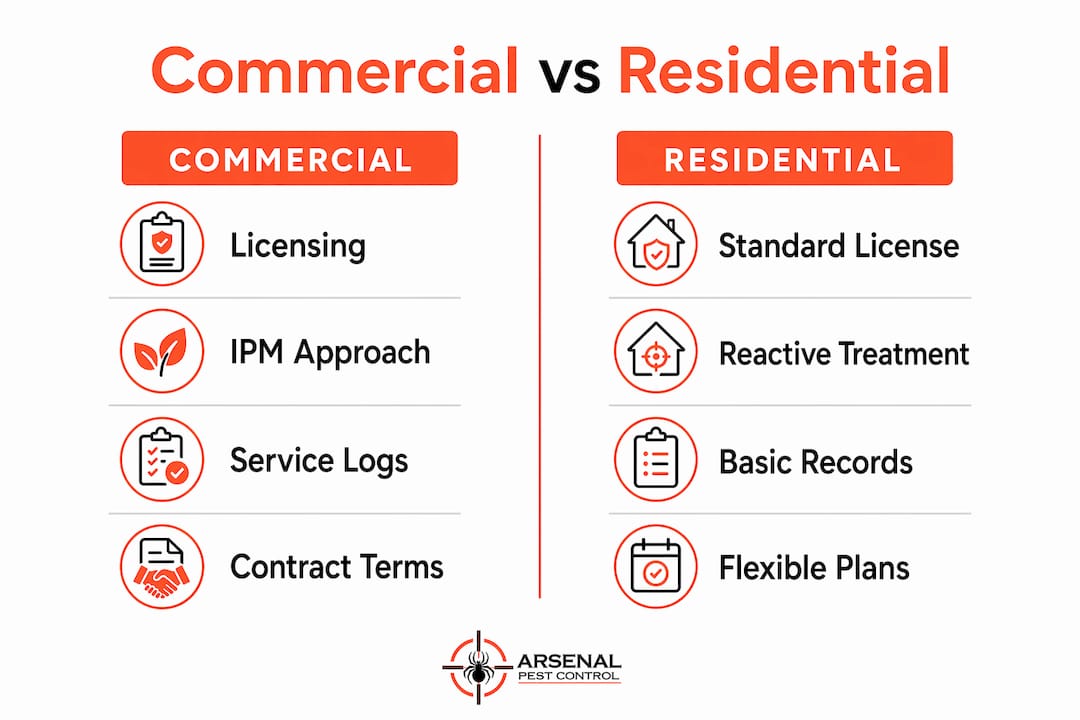
Commercial pest control documentation requirements go well beyond what residential clients face. Businesses must maintain service logs, chemical usage reports, and monitoring records to pass health and safety audits. A health inspector can request these records on the spot, and missing documentation is treated the same as a violation.
Phoenix property owners face an additional layer of local code. Phoenix Section 39-5 mandates that property owners maintain pest-free premises, with fines reaching $2,500 or forced abatement for non-compliance. That applies to both commercial and residential landlords, though the enforcement pressure falls hardest on businesses.
Arizona’s regulatory framework also assigns pest control responsibility in rental properties based on infestation source under ARS §33-1324. This complicates management for landlords compared to owner-occupied homes, since determining who caused the infestation affects who pays for treatment.
Here is how the documentation requirements break down for commercial operators:
- Service logs: date, time, technician name, and areas treated for every visit
- Chemical usage records: product name, EPA registration number, quantity applied, and target pest
- Monitoring station reports: trap check results and pest activity trends over time
- Corrective action records: any follow-up treatments and the reason they were required
- Pest sighting logs: staff-reported pest activity between scheduled visits
Pro Tip: Set up a dedicated pest management log binder or digital folder from day one. Health inspectors treat missing records as evidence of non-compliance, even if your facility is actually pest-free.
What pests are most common in Arizona commercial vs residential properties?
Arizona’s Sonoran Desert climate creates year-round pest pressure that intensifies for businesses. Residential pest control in Arizona typically targets ants, spiders, termites, rodents, and scorpions, with seasonal surges in cricket and bee activity. These pests affect family comfort and property integrity, but they rarely trigger regulatory consequences for homeowners.
Commercial properties face a different pest profile. Restaurants, warehouses, and healthcare facilities deal with cockroaches, stored product pests, flies, and rodents at much higher pressure levels. Foot traffic, food storage, and loading dock access create entry points and food sources that simply do not exist in residential settings.
The consequences of infestation also differ sharply. Rodents or cockroaches in a restaurant can trigger a failed health inspection, a public violation posting, and immediate closure. A single social media photo of a cockroach in a dining room can cost a business far more than any pest control contract.
- Residential pests: bark scorpions, black widow spiders, roof rats, Argentine ants, subterranean termites, Africanized bees
- Commercial pests: German cockroaches, Norway rats, Indian meal moths, house flies, fruit flies, stored grain beetles
- Shared risks: termites, rodents, and ants affect both property types but require different treatment scales
The Sonoran Desert heat drives pests indoors during summer months, which means both homeowners and business owners face peak pressure from june through september. Commercial properties with outdoor dining, open loading bays, or food waste storage face the highest risk during this window.
How do costs and contract structures compare?
Commercial pest control carries a measurable price premium over residential service. Businesses typically pay 15–30% more than residential clients for comparable square footage, driven by compliance documentation, after-hours availability, and the specialized training required for commercial-grade IPM programs. That premium reflects real operational costs, not arbitrary pricing.
Residential pricing is more standardized. Most providers base quotes on home size, pest type, and service frequency. A quarterly general pest program for a 2,000-square-foot home in Gilbert or Mesa will cost far less than a monthly commercial program for a 5,000-square-foot restaurant, even before factoring in documentation requirements.
Commercial contracts also carry different structural expectations. Multi-year agreements are common, often with discounts for longer commitments. Emergency response guarantees, defined response windows, and service level agreements are standard terms in a commercial pest control contract. Residential agreements, by contrast, tend to be month-to-month or annual with easy cancellation.
For a useful external perspective on commercial pricing factors and how compliance drives cost in regulated markets, the breakdown applies broadly across commercial pest control contexts.
The key cost drivers for commercial clients include property size, infestation severity at contract start, service frequency, number of monitoring stations required, and whether after-hours or weekend service is needed. Residential clients pay primarily based on home size and the specific pests being treated.
Pro Tip: Never compare a commercial pest control quote to a residential one on a per-square-foot basis. The documentation, compliance work, and emergency response built into commercial pricing are not present in residential contracts.
Key Takeaways
Commercial pest control requires stricter licensing, detailed documentation, and proactive IPM programs, while residential pest control prioritizes family safety with flexible, seasonal treatment schedules.
| Point | Details |
|---|---|
| IPM vs reactive treatment | Commercial pest control uses Integrated Pest Management; residential services are typically seasonal or reactive. |
| Documentation is mandatory | Commercial operators must maintain service logs, chemical records, and monitoring reports to pass health audits. |
| Arizona licensing is non-negotiable | Both applicators and pest control businesses must hold current Arizona Department of Agriculture licenses. |
| Cost premium is real | Commercial clients pay 15–30% more than residential clients due to compliance, documentation, and after-hours service. |
| Pest profiles differ | Businesses face cockroaches, stored product pests, and flies; homes deal with scorpions, termites, and ants. |
What we have learned from serving both sides of the fence
After working with homeowners and business owners across Queen Creek, Gilbert, Mesa, and the broader East Valley, one pattern stands out clearly. Property owners who use a residential pest control provider for their commercial space almost always run into compliance problems. The service logs are incomplete, the chemical records do not meet audit standards, and the technician has no experience with health inspection requirements. It is not a question of effort. It is a question of training and systems.
The other mistake we see regularly is business owners waiting until they have an active infestation to set up a commercial pest control plan. By that point, the damage to reputation and the cost of remediation are both higher than a year of preventative service would have been. Proactive IPM is not a luxury for Arizona businesses. It is the only approach that keeps you ahead of health inspectors and pest pressure simultaneously.
For homeowners, the calculus is different but equally clear. You do not need the documentation burden of a commercial program. You do need a licensed provider using products that are safe around your family and effective against Arizona’s specific pest mix, including bark scorpions, termites, and Africanized bees. Verify your provider’s Arizona Department of Agriculture license before the first treatment, regardless of whether you own a home or a business.
The best pest control plan, commercial or residential, is one built around your specific property, pest history, and risk level. Generic programs miss the details that matter most in Arizona’s climate.
— Arsenal Pest Control
Arsenal Pest Control serves Arizona homes and businesses
Arsenal Pest Control holds the commercial and residential licenses required under Arizona Department of Agriculture rules, and our technicians are trained in IPM methodology and full compliance documentation.

Whether you own a home in Queen Creek or manage a commercial property in Chandler, Arsenal Pest Control builds a plan around your actual pest risks. Our pest control services cover scorpion control, termite treatments, rodent programs, ant control, and commercial compliance programs across the East Valley. We do not use long-term contracts, and every treatment uses environmentally responsible products. Families dealing with scorpions or termites can also review our guidance on safe pest control for kids and pets to understand exactly what goes into your home. Contact Arsenal Pest Control to schedule an inspection and get a plan that fits your property.
FAQ
What is commercial pest control?
Commercial pest control is a licensed pest management service for businesses that combines Integrated Pest Management, regulatory compliance documentation, and scheduled monitoring to protect facilities from pest-related health and legal risks.
What documentation does a commercial pest control service require?
Commercial pest control documentation includes service logs, chemical usage records, monitoring station reports, and corrective action records. These are required to pass health and safety audits under Arizona regulations.
How does a commercial pest control contract differ from residential?
A commercial pest control contract typically includes defined service frequencies from weekly to monthly, emergency response guarantees, and documentation requirements. Residential agreements are generally simpler, more flexible, and do not include compliance reporting.
What are the pest control log requirements for Arizona businesses?
Arizona businesses must maintain records of every service visit, including the date, technician, products applied, and pest activity observed. Missing records are treated as a compliance violation during health inspections.
Can a residential pest control provider service a commercial property?
Using a residential pest control provider for a commercial property creates compliance risk. Commercial sites require providers with specific commercial licensing, IPM training, and documentation systems that standard residential programs do not include.
Recommended
- Seasonal Pest Control for Commercial Property: 2026 Guide – Arsenal Pest Control
- What Is Quarterly Pest Service? A Homeowner’s Guide – Arsenal Pest Control
- Pest Control Services Mesa AZ | Arsenal Pest Control
- Pest Control Services Gilbert AZ | Arsenal Pest Control
