



Seasonal pest control for commercial property is a continuous, data-driven process that uses Integrated Pest Management (IPM) principles to anticipate pest activity before it becomes an infestation. IPM is the recognized industry standard for commercial facilities, combining monitoring, exclusion, sanitation, and targeted treatments to reduce pest pressure across every season. A reactive approach, where you spray only after spotting pests, consistently fails because visible pest activity often signals an already large infestation. Standards like BRCGS and ISO 22000 now require documented, audit-compliant pest programs, making a tailored seasonal strategy a compliance necessity, not just a best practice.
How do seasonal pest behaviors impact commercial property pest control strategies?
Pest activity follows predictable cycles tied to temperature, humidity, and biological rhythms. That predictability is your biggest advantage as a property manager. When you know what pests are coming and when, you can act before they arrive rather than scrambling after the fact.
Here is how pest pressure shifts across the calendar year:
- Spring: Ants, termites, and stinging insects emerge as temperatures rise. Termite swarm season peaks in spring across the Southwest, making this the right time to schedule termite inspections.
- Summer: Flies, mosquitoes, and cockroaches reach peak reproduction. Heat and humidity accelerate breeding cycles, so food service and warehouse facilities face the highest pressure during these months.
- Fall: Rodents begin moving indoors as outdoor temperatures drop. Spiders and occasional invaders like crickets also push through gaps and cracks seeking warmth.
- Winter: Rodent activity inside buildings peaks. Cockroach populations that established indoors during summer continue to thrive in heated spaces.
Property type shapes pest pressure significantly. A restaurant faces fly and cockroach risks that a suburban office building rarely encounters. Moisture-prone older masonry buildings demand different exclusion and monitoring strategies than newer dry-climate structures. Building age, local urban density, and proximity to green spaces all shift the risk profile.
Pro Tip: Map your property’s microclimates. Loading docks, dumpster enclosures, and HVAC intake areas are consistently the highest-risk zones regardless of season. Treat them as priority inspection points year-round.

A static pest control schedule ignores all of this. Adjusting tactics seasonally, based on what pests are actually doing, is what separates a program that works from one that just generates invoices.
What is an IPM program and how does it enable effective seasonal pest control?
Integrated Pest Management is defined as a science-based approach that combines monitoring, exclusion, sanitation, biological controls, and chemical treatments used only as a last resort. The goal is to keep pest populations below a threshold that causes harm, using the least disruptive methods first.
The core components of a commercial IPM program work in sequence:
- Monitoring: Install traps, bait stations, and pheromone monitors at key locations. Review catch data regularly to identify trends before populations spike.
- Exclusion: Seal entry points including door gaps, pipe penetrations, vents, and cracks. This is the single most cost-effective pest control action available.
- Sanitation: Remove food sources, standing water, and harborage areas. Staff behavior and daily cleaning routines directly determine how effective any treatment will be.
- Biological controls: Use natural predators or microbial agents where appropriate, particularly for fly management in food production environments.
- Chemical treatments: Apply targeted, low-impact products only when monitoring data confirms a threshold has been crossed. Broad-spectrum spraying on a fixed schedule is not IPM.
IPM programs reduce chemical pesticide use by 60–80% compared to reactive fixed-schedule spraying. That reduction matters for three reasons: lower chemical exposure for staff and customers, reduced environmental impact, and lower long-term costs.
| Approach | Chemical Use | Flexibility | Audit Compliance |
|---|---|---|---|
| Reactive spraying | High | None | Poor |
| Fixed-schedule program | Moderate | Low | Partial |
| IPM-based program | Low | High | Strong |
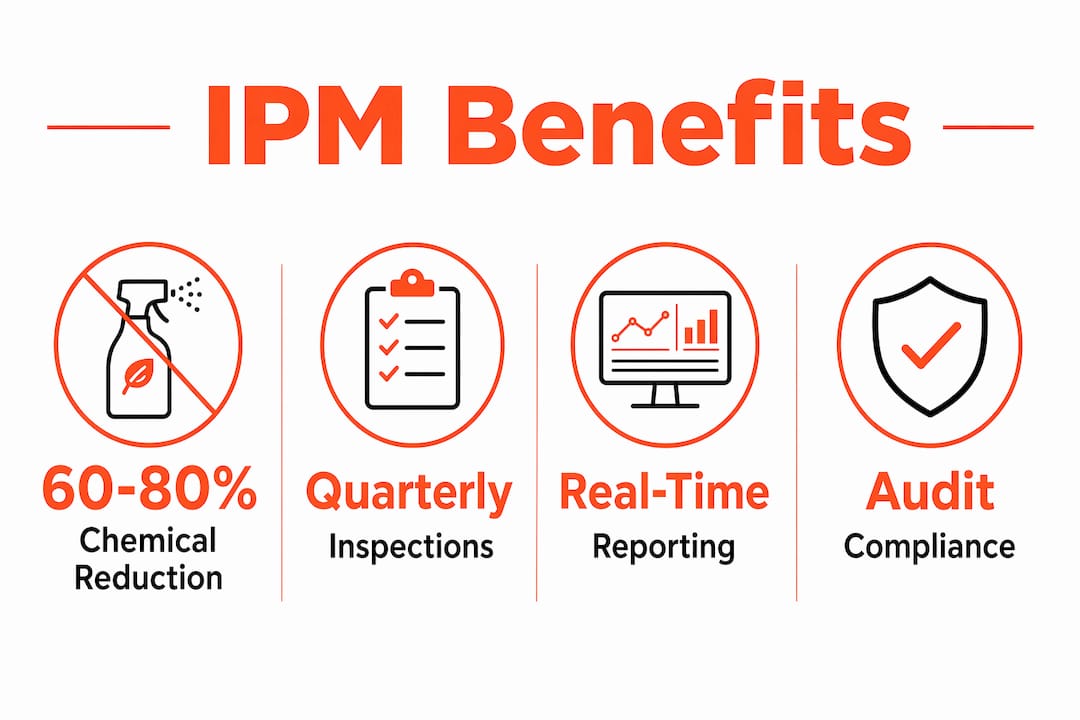
Audit-compliant pest management requires digitized, real-time reporting, trend analysis, and clear documentation of every IPM measure taken. BRCGS and ISO 22000 auditors look for this paper trail. Without it, even a well-run program fails on paper.
Pro Tip: Train your maintenance and cleaning staff to report pest sightings immediately using a simple digital log. Early internal reports are often the first signal of a developing problem, weeks before traps catch anything.
Staff training is not optional in a real IPM program. The people inside your building every day are your best early-warning system.
How to build a seasonal pest control schedule for your commercial property
A pest control schedule for commercial property starts with a facility pest audit. This audit, sometimes called a facilities pest audit or pest control audit, maps every area of your property by risk level. High-traffic zones, food prep areas, waste storage, and utility corridors get flagged as priority zones requiring more frequent attention.
Follow these steps to build a schedule that actually fits your property:
- Conduct a baseline facility pest audit. Walk every area with your pest professional and document conditions: entry points, moisture sources, sanitation gaps, and existing pest evidence. This audit becomes the foundation of your program.
- Segment zones by risk. Kitchens, loading docks, and waste areas are high-risk. Private offices and dry storage are typically standard-risk. Each zone gets its own inspection frequency.
- Set service frequency by risk level. Standard-risk properties benefit from quarterly inspections; high-risk industries like food service and healthcare often need monthly or weekly monitoring of critical zones. Frequency is driven by pest pressure, not convenience.
- Build season-specific priorities into the calendar. Schedule termite inspections in spring, intensify fly control programs in summer, execute rodent exclusion work in early fall before temperatures drop, and use winter for structural repairs and off-season monitoring reviews.
- Use monitoring data to adjust dynamically. Zero-catch trap results justify reducing visit frequency; a sudden spike in catches requires immediate escalation. Your schedule should flex with the data, not ignore it.
- Assign internal roles. Designate a staff member to check and log monitoring devices between professional visits. This keeps the program active every week, not just on service days.
| Season | Priority Action | Target Pests |
|---|---|---|
| Spring | Termite inspection, ant barrier treatments | Termites, ants, stinging insects |
| Summer | Fly control, drain cleaning, mosquito treatment | Flies, mosquitoes, cockroaches |
| Fall | Rodent exclusion, gap sealing, bait station placement | Rodents, spiders, crickets |
| Winter | Structural repairs, monitoring review, program audit | Rodents, overwintering cockroaches |
Pairing your seasonal calendar with a commercial vent cleaning schedule adds another layer of protection. Vent systems are a common but overlooked pest entry and harborage point, particularly for rodents and cockroaches.
A maintenance pest control program built on inspection, prevention, targeted treatment, and follow-up keeps pest presence minimal and predictable. Reactivity leads to costly disruptions. A documented schedule prevents both.
What mistakes do commercial property managers make with seasonal pest control?
The most common mistake is treating a pest sighting as a failure rather than an early warning. Relying on visible pest activity to trigger action means you are already behind. By the time you see a rodent in a hallway or flies swarming a drain, the population is established.
Other frequent mistakes include:
- Over-relying on chemical treatments without structural proofing. Spraying without sealing entry points is like bailing a boat without plugging the hole. Chemicals suppress populations temporarily; exclusion stops reinfestation.
- Using a rigid fixed schedule regardless of monitoring data. Paying for monthly visits when traps show zero activity wastes money. Skipping visits during a seasonal spike invites infestation.
- Neglecting staff training and internal reporting. A pest professional visits your property a few times per month at most. Your staff is there every day. Without a reporting system, early warnings go unnoticed.
- Delaying exclusion work until pests are already present. Sealing entry points early in the off-season prevents infestation escalation during breeding seasons. This work is far cheaper than emergency treatments.
Third-party pest audits provide unbiased assessments that routine contractor visits cannot. Independent audits often reveal deep-seated structural or operational pest risks missed by the regular service provider, and they are frequently required for food safety certifications. If your program has never been reviewed by an outside party, you do not actually know how well it is working.
Pro Tip: Document everything. Date-stamped photos, catch counts, treatment records, and corrective action notes create the audit trail that protects you during BRCGS or ISO 22000 inspections and gives your pest professional the data needed to improve the program.
Troubleshooting a seasonal spike means first checking whether monitoring data predicted it. If traps showed rising catch counts two weeks before the spike, the schedule needed adjustment earlier. If the spike was genuinely sudden, investigate environmental triggers: a nearby construction project, a new food waste source, or a structural breach.
Key Takeaways
Effective seasonal pest control for commercial properties requires a dynamic, IPM-based program that adjusts to seasonal pest cycles, property risk levels, and real-time monitoring data rather than a fixed spray schedule.
| Point | Details |
|---|---|
| IPM reduces chemical use | IPM programs cut pesticide use by 60–80% compared to reactive spraying. |
| Schedule by risk, not routine | High-risk facilities need monthly or weekly monitoring; standard-risk properties need quarterly visits. |
| Exclusion before breeding season | Seal entry points in the off-season to prevent infestation escalation during peak pest activity. |
| Data drives adjustments | Zero-catch results justify fewer visits; catch spikes require immediate escalation of treatments. |
| Audits reveal hidden risks | Third-party pest audits identify structural and operational risks that routine service visits miss. |
What I have learned from years of seasonal pest work on commercial properties
The property managers who get the best results are the ones who stop thinking about pest control as a service they purchase and start treating it as a program they run. That shift in mindset changes everything.
The biggest mistake I see repeatedly is waiting for a problem to become visible before acting. Pest biology does not care about your service schedule. Ants start building colonies in february. Rodents start scouting entry points in september. If your program is not already positioned for those threats before they materialize, you are reacting, not managing.
I have also seen how much damage a rigid schedule does to a program’s effectiveness. When monitoring data shows zero activity for three consecutive months, that is a signal to review your exclusion work and confirm it is holding, not a reason to keep sending a technician on autopilot. Conversely, when catch counts double in a week, that is not a scheduling anomaly. It is a call to act immediately.
The facilities that perform best under BRCGS and ISO 22000 audits are not the ones with the most expensive programs. They are the ones with the best documentation and the clearest evidence of a data-driven decision process. Auditors want to see that you responded to monitoring data, corrected deficiencies, and trained your staff. That story is told through records, not through how many times a technician visited.
Seasonal understanding and early exclusion planning are not advanced concepts. They are the foundation. Build on them, and the rest of the program becomes much easier to manage.
— Arsenal
Arsenalexterminating’s seasonal pest control services for commercial properties
Commercial property managers in Queen Creek, Gilbert, Chandler, Mesa, and surrounding Arizona communities work with Arsenalexterminating for seasonal pest management built on IPM principles, not reactive spraying.

Arsenalexterminating provides facility inspections, exclusion work, targeted seasonal treatments, and documentation that meets audit standards, all without long-term contracts. The program adapts to your property’s risk profile and adjusts service frequency based on monitoring data, not a fixed calendar. From spring termite inspections to fall rodent exclusion, every service is matched to what Arizona’s seasonal pest cycles actually demand. Learn more about Arsenalexterminating’s commercial pest control services and request a facility assessment for your property.
FAQ
What is seasonal pest control for commercial properties?
Seasonal pest control for commercial properties is a structured, year-round pest management program that adjusts monitoring, exclusion, and treatment tactics based on predictable seasonal pest activity cycles. It uses IPM principles to anticipate pest pressure rather than react to visible infestations.
How often should commercial pest control be done?
Standard-risk commercial properties generally need quarterly inspections, while high-risk facilities like restaurants and healthcare buildings require monthly or weekly monitoring of critical zones. Service frequency should be driven by monitoring data and property risk, not a uniform schedule.
What is a facility pest audit?
A facility pest audit is a structured inspection that maps a commercial property by pest risk level, identifying entry points, harborage areas, sanitation gaps, and monitoring needs. It forms the baseline for building a tailored pest control schedule.
How does IPM reduce chemical use in commercial pest control?
IPM programs reduce chemical pesticide use by 60–80% by replacing broad-spectrum spraying with targeted treatments applied only when monitoring data confirms a pest threshold has been crossed. Exclusion and sanitation handle the majority of pest prevention.
Why do commercial properties need third-party pest audits?
Independent third-party pest audits identify structural and operational risks that routine service visits miss and are often required for food safety certifications like BRCGS and ISO 22000. They provide an unbiased assessment of whether your program is actually working.
Recommended
- About Arsenal Exterminating, Eco-friendly Pest Control
- Pest Control Services Queen Creek, AZ | Arsenal Exterminating
- Pest Control Services Gilbert AZ | Arsenal Pest Control
